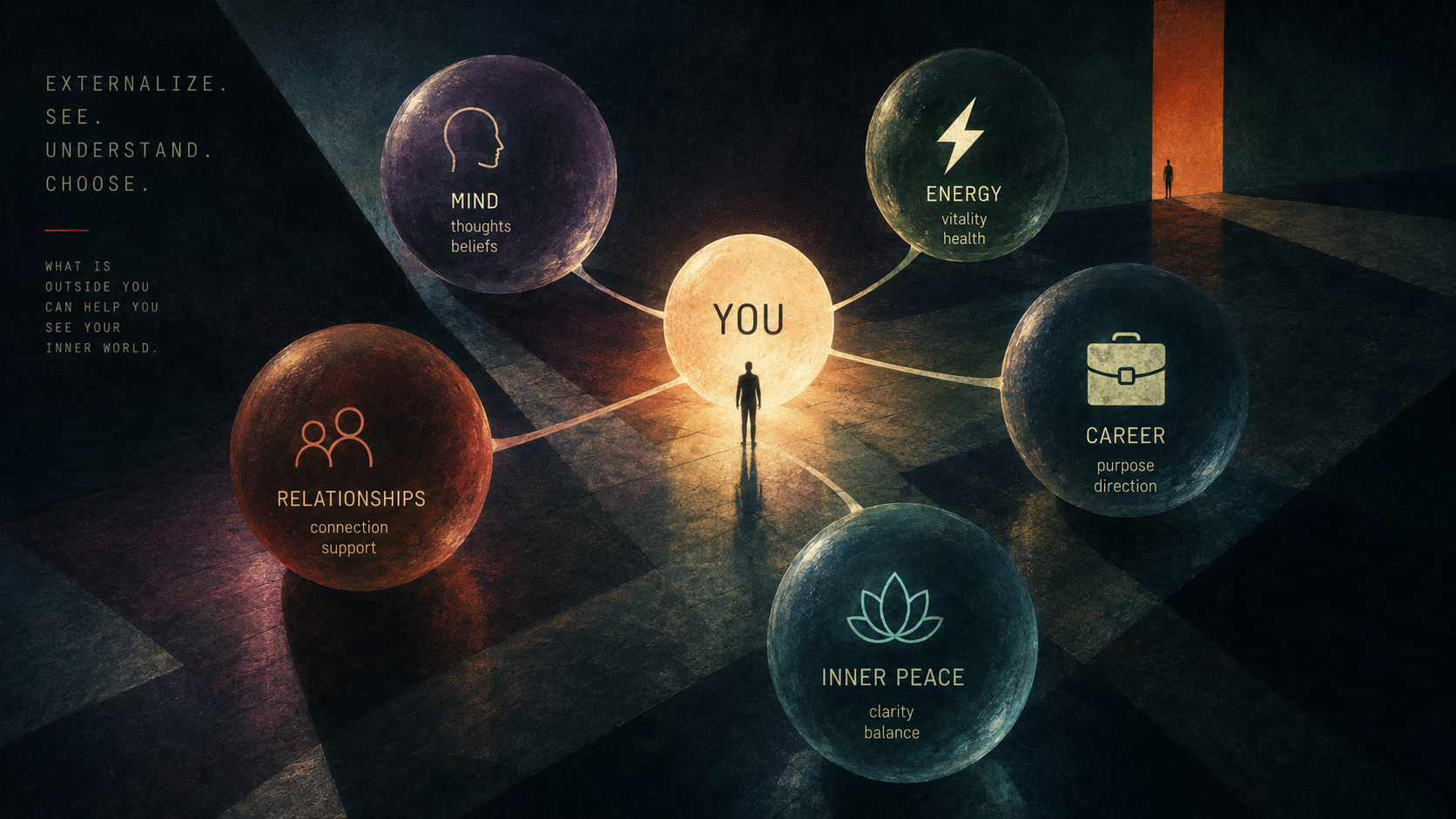
When we experience intense stress or anxiety, our brain makes a subtle but dangerous error: it merges our identity with the emotion itself. We stop thinking “I am experiencing worry right now” and start feeling “I am an anxious person.”
In narrative psychology, the antidote to this state is called externalization—the process of taking internal mental noise and placing it outside of yourself so you can observe it objectively.
Why “Inside Your Head” Is the Worst Place to Solve a Problem
When thoughts remain strictly inside your mind, your amygdala (the brain's threat center) treats every vague worry as an immediate, active danger. Because there is no physical boundary between you and the thought, your body reacts with continuous background tension.
Attempting to untangle complex emotional states using pure willpower inside your head usually leads to rumination—repeating the same stressful scenarios in a loop without reaching resolution.
The Science of Spatial Externalization
Visualizing your thoughts as tangible objects on a 2D or 3D canvas changes the way your brain processes information:
- Shift to the Observer Perspective: By viewing a map of your internal state, you activate the prefrontal cortex—the rational part of your brain responsible for planning and emotional regulation.
- Visual Distance Equals Emotional Distance: When you physically push an object (like a project deadline or a conflict) further to the edge of a canvas, your brain perceives it as less threatening to your core sense of self.
- Pattern Recognition: On a spatial canvas, hidden connections instantly become obvious. You can immediately see if your energy is skewed entirely toward work while health or relationships are left neglected.
Map Your World with Life Map AI
Life Map AI was built on the foundation of narrative therapy and spatial cognitive psychology.
Instead of getting lost in the storm of your thoughts, you can visually map your values, current states, goals, and worries around a clear center: YOU.
By externalizing your mind into an intuitive visual landscape, you regain control, reduce cognitive fatigue, and gain a profound sense of perspective in just a few minutes.