Anton Borts, BSW
Founder & Creator of Life Map AI
M.A. Psychology Candidate | Social Worker | Psychology Researcher
Almost everyone has noticed it at least once: a decision that felt new turns out to be an old decision in fresh clothing. The same kind of job, the same kind of partner, the same kind of argument, the same kind of exit. The details change; the shape does not. We often interpret this as a personal failing — a lack of willpower, a lack of insight, a lack of discipline. Decision science suggests something less flattering to the story of the isolated, rational chooser and also less shameful: repeated decisions are usually the visible surface of repeated inner conditions.
Decisions Are Not Just Decisions
In everyday language, a decision is a single moment: you choose A over B. In cognitive psychology, that moment is the last step of a much longer process. Herbert Simon called it bounded rationality: real people decide inside limits of attention, time, information, and emotion. Daniel Kahneman and Amos Tversky went further, showing that most choices are shaped by fast, automatic reactions long before deliberation begins. By the time you "pick," a great deal has already been decided by memory, mood, framing, and habit.
This is why identical situations produce non-identical choices — and why non-identical situations can produce eerily identical ones. The surface option changes, but the underlying configuration is stable.
The Hidden Machinery Behind a Repeated Choice
When a decision keeps returning, a few forces are almost always in the room together.
1. Memory — but not the memory you think you have
Memory does not replay the past; it reconstructs it. Elizabeth Loftus and Frederic Bartlett before her showed that recall is influenced by current beliefs, present emotion, and the story we are telling ourselves about who we are. Martin Conway's work on autobiographical memory suggests that we remember in ways that keep our sense of self coherent. If a past choice is stored as "that's just what people like me do," the next similar choice will feel obvious rather than considered.
2. Emotion as a decision signal
Antonio Damasio's somatic-marker hypothesis proposes that emotions are not opposed to reasoning — they are part of it. Feelings tag options as attractive, threatening, safe, or shameful before conscious analysis catches up. If a certain kind of relationship, job, or environment consistently produces a familiar internal signal — a specific tension, a specific relief — that signal will steer future choices even when logic points elsewhere.
3. Identity and self-concept
People rarely choose against their own self-image for long. When a decision would require someone to become a different kind of person than they believe themselves to be, they usually retreat to a choice that confirms the existing story. This is not weakness; it is cognitive economy. Identity is expensive to change.
4. Context and environment
Behavioral research from Dan Ariely to Richard Thaler makes it clear that context often decides more than character. The people around us, the incentives we live inside, the choices that are made easy versus hard, the defaults we never override — these shape decisions more reliably than intention. Change the environment and the "same" person makes different choices.
5. Cognitive load and depletion
When attention is scarce, the brain reaches for what is familiar. Roy Baumeister's early work on ego depletion has been refined, but the pattern remains: under stress, fatigue, or overload, deliberate choice gives way to defaults. Repeated decisions are often defaults in disguise.
Why Insight Alone Rarely Breaks the Pattern
A common assumption is that understanding a pattern is enough to end it. In practice, awareness is necessary but insufficient. Angela Duckworth's work on self-regulation, and a large body of therapeutic evidence, suggest that behavior change requires more than insight — it requires new cues, new environments, new practiced alternatives, and often new emotional experiences that the old pattern was quietly avoiding.
This is why intelligent people repeat obviously costly choices. They can name the pattern. They can explain it. And they still stand in front of the same door because the door is only the last step of a long sequence they cannot see from the inside.
The View from a Cognitive Operating System
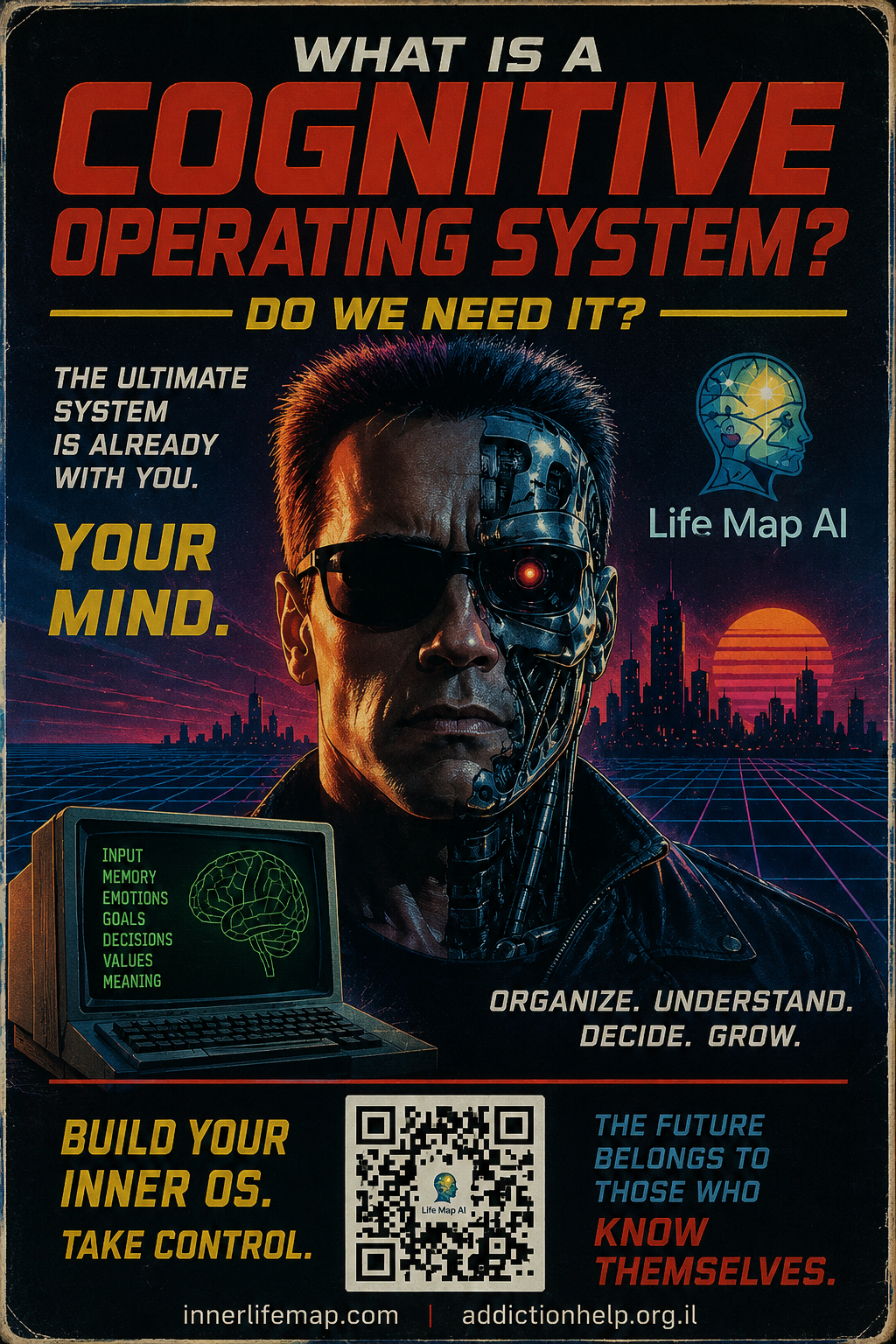
A Cognitive Operating System, in the sense used at Life Map AI, is not a decision-maker. It is a structure that lets a person see the conditions under which they decide. Instead of asking, "Was that the right choice?" it makes it possible to ask, "What was true about me, about my life, and about my environment when I made it — and is any of that true again now?"
This reframes repeated decisions. They stop looking like flaws in a person and start looking like reliable evidence: the same result implies the same inputs. When the inputs become visible — memory, emotion, identity, context, load — the repetition becomes editable rather than mysterious.
Where AI Belongs in This Picture
Personal AI is often described as a tool that will make better decisions on our behalf. That framing misses the interesting possibility. A reflective AI companion, working with a person's own history, is well suited to a narrower and more honest role: surfacing the recurring configurations behind recurring choices, without pretending to know what the person should do next.
Compared with a human observer, AI can compare many past moments at once, notice long-arc regularities that memory smooths over, and hold a non-judgmental mirror to patterns the person already half-knows. Compared with an autonomous decision-maker, it declines to move the weight of choice off the human — because the weight of choice is precisely where growth happens.
The point is not to be told what to decide. The point is to see clearly what one is deciding from.
A Practical Definition of Progress
In this framing, progress is not the absence of repeated decisions. Some patterns are worth keeping; they encode hard-won values. Progress is the shift from unconscious repetition to conscious choice — being able to say, "I recognize this shape, I have chosen it before, and this time I am choosing it (or refusing it) with open eyes."
Repetition, seen this way, is not evidence of failure. It is one of the clearest data sources a person has about who they currently are — and about which parts of that self are ready to be edited.
References
- Simon, H. A. (1955). A behavioral model of rational choice. Quarterly Journal of Economics, 69(1), 99–118.
- Kahneman, D., & Tversky, A. (1979). Prospect theory: An analysis of decision under risk. Econometrica, 47(2), 263–291.
- Kahneman, D. (2011). Thinking, Fast and Slow. Farrar, Straus and Giroux.
- Bartlett, F. C. (1932). Remembering: A Study in Experimental and Social Psychology. Cambridge University Press.
- Loftus, E. F. (1996). Eyewitness Testimony (Rev. ed.). Harvard University Press.
- Conway, M. A. (2005). Memory and the self. Journal of Memory and Language, 53(4), 594–628.
- Damasio, A. R. (1994). Descartes' Error: Emotion, Reason, and the Human Brain. Putnam.
- Thaler, R. H., & Sunstein, C. R. (2008). Nudge: Improving Decisions About Health, Wealth, and Happiness. Yale University Press.
- Ariely, D. (2008). Predictably Irrational: The Hidden Forces That Shape Our Decisions. HarperCollins.
- Baumeister, R. F., Bratslavsky, E., Muraven, M., & Tice, D. M. (1998). Ego depletion: Is the active self a limited resource? Journal of Personality and Social Psychology, 74(5), 1252–1265.
- Duckworth, A. L., Gendler, T. S., & Gross, J. J. (2016). Situational strategies for self-control. Perspectives on Psychological Science, 11(1), 35–55.