VISUAL THINKING:
WHY SEEING A PROBLEM CAN CHANGE THE WAY WE UNDERSTAND IT
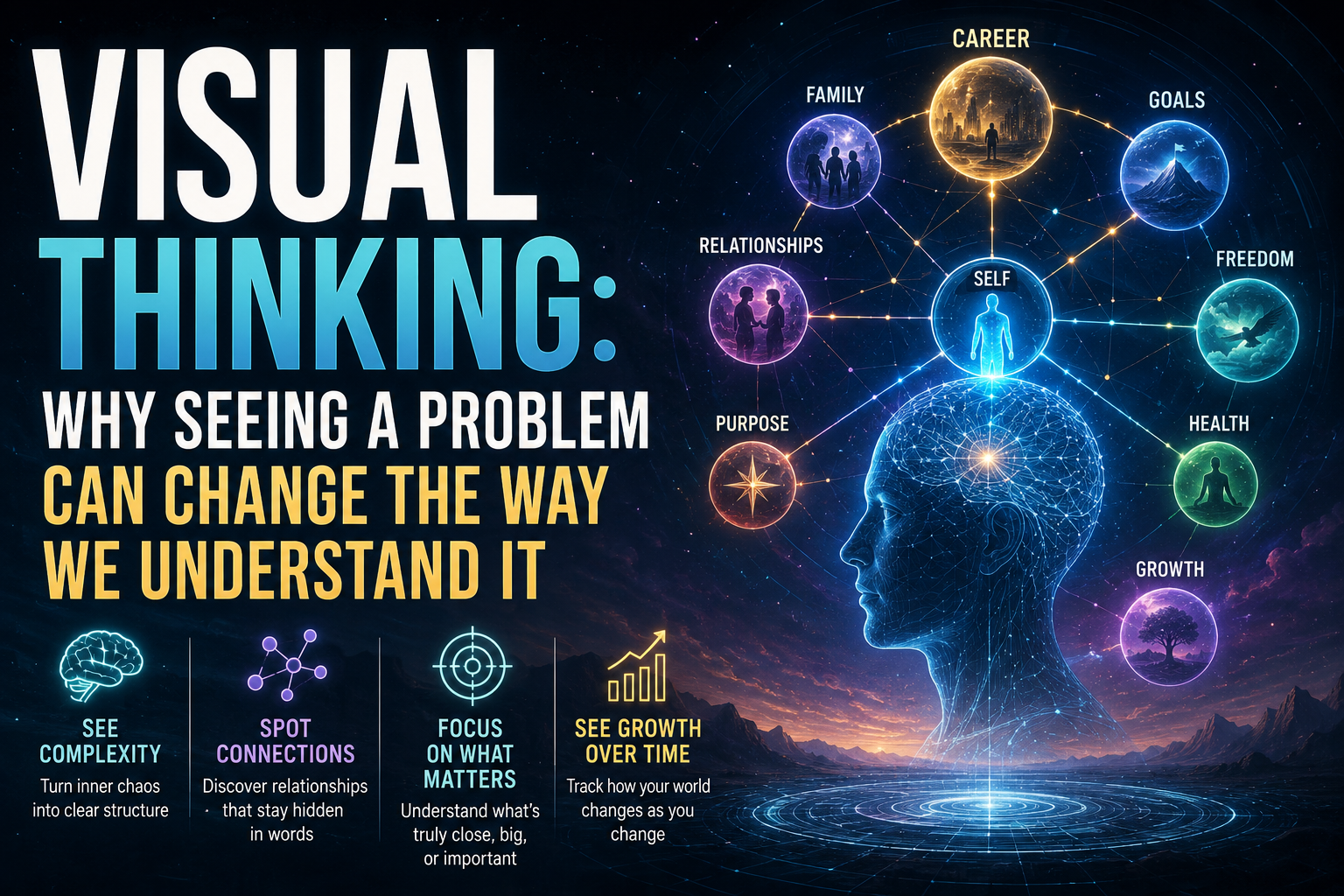
SEE COMPLEXITY
Turn inner chaos into clear structure
SPOT CONNECTIONS
Discover relationships that stay hidden in words
FOCUS ON WHAT MATTERS
Understand what's truly close, big, or important
SEE GROWTH OVER TIME
Track how your world changes as you change
Most of us are taught to think through words — writing lists, journaling, and maintaining an internal dialogue. Language is a powerful cognitive tool, but complex life situations rarely unfold as neatly as sentences. A difficult career decision may involve finances, family, ambition, fear, and identity all at once. Thinking about them sequentially can make the situation feel overwhelming.
Visual thinking offers another way to manage complexity. It uses space, position, size, and grouping to externalize information that would otherwise clutter working memory. Cognitive scientists Jiajie Zhang and Donald Norman described cognition as something distributed between internal mental representations and external environments. Their work shows that how information is represented externally fundamentally changes how we solve a problem.
Imagine thinking: 'My career takes too much attention. Financial security keeps me there. Family is important, but I want freedom.' In a journal, these thoughts appear sequentially. On a spatial canvas, Career might sit large near the center, Financial Security connected to it, Family nearby, and Freedom farther away. This doesn't make the visual version more 'true'; it simply makes proximity, relative prominence, and competing directions instantly visible.
Spatial representations are inherently powerful. A review in Nature Reviews Psychology explains how visualizations use space to organize information and support attention, perception, and memory. Furthermore, externalizing thoughts reduces working memory load. Instead of holding complex chains of cause-and-effect in your head, relationships remain visible on screen.
From Visual Thinking to Self-Reflection
This principle is especially transformative when applied to personal reflection. Instead of keeping a fear, goal, or conflict purely inside an internal narrative, a person turns it into an observable object that can be positioned, compared, and reconsidered.
This connects to research on self-distancing by Ethan Kross and Özlem Ayduk, which shows that adopting psychological distance from difficult experiences facilitates adaptive self-reflection and reduces rumination. There is a profound difference between saying 'I am overwhelmed' and looking at a map where Stress is just one element alongside Career, Family, Health, and Future Plans. The emotion doesn't disappear, but it becomes part of a larger, visible structure.
In responsible spatial self-reflection, the system never imposes conclusions (e.g., asserting that close placement equals identity). Instead, it acts as a neutral mirror: 'Career is currently near the center. Does that feel meaningful to you?' The map provides structure; the person remains the interpreter.
Beyond Traditional Mind Maps
Personal experience is rarely hierarchical, making traditional mind maps too rigid. A relationship can simultaneously represent love and stress; a career connects to money, ambition, and fear. Spatial reflection allows richer dimensions to carry meaning:
- Distance: represents perceived closeness or relevance.
- Size: reflects subjective weight.
- Connections: show explicit relationships.
- Movement: tracks how representations change over time.
This is the foundation of Life Map AI. Instead of relying solely on text, users place people, goals, stressors, and values around a central Self. AI then supports reflection without claiming to uncover hidden psychological truths. Over months, preserving how life elements were arranged allows users to observe shifts — a goal moving closer, a fear shrinking, or new connections forming.
A Different Way to Think
Visual thinking does not replace writing. Journaling excels at narrative, while spatial representation adds a structural layer. Writing asks: What am I thinking? Visual thinking asks: What is close to me? What is competing for my attention? What has changed?
The future of personal AI lies beyond conversational chatbots. Instead of AI trying to interpret a person solely through words, individuals can map their experiences visually and invite AI to help examine those structures. The system doesn't create meaning for you — it helps you see what you created and ask better questions.
Scientific References
- • Zhang, J., & Norman, D. A. (1994). Representations in Distributed Cognitive Tasks. Cognitive Science, 18(1), 87–122.
- • Kross, E., & Ayduk, O. (2011). Making Meaning out of Negative Experiences by Self-Distancing. Current Directions in Psychological Science, 20(3).
- • Taylor, H. A., Burte, H., & Renshaw, K. T. (2023). Connecting Spatial Thinking to STEM Learning Through Visualizations. Nature Reviews Psychology, 2, 637–653.
- • Cook, M. P. (2006). Visual Representations in Science Education: The Influence of Prior Knowledge and Cognitive Load Theory. Science Education, 90(6), 1073–1091.