Anton Borts, BSW
Founder & Creator of Life Map AI
M.A. Psychology Candidate | Social Worker | Psychology Researcher
Abstract
The dominant narrative around artificial intelligence assumes that the next frontier is smarter models: larger context windows, better reasoning, more agentic behavior. This article proposes a different frontier — one that does not compete with AI at all. It argues that as machines become capable of thinking on our behalf, the ability of a human being to understand their own mind becomes the scarcer, more consequential capacity. The article introduces the concept of a Cognitive Operating System (COS)— a human-side infrastructure that helps people observe, structure, and update the memories, emotions, beliefs, and patterns shaping how they think, feel, and decide. A COS is not another AI product. It is the reflective layer that makes AI, and the rest of a person’s life, usable without losing authorship of one’s own thoughts.
1. The Real Question Is Not About AI
Public discourse about AI is preoccupied with capability: what models can do, what jobs they will replace, how quickly they will improve. These are legitimate questions, but they obscure a quieter one that will matter more over the next decade:
If AI can think, plan, and act on our behalf, who is running the person?
A model that writes an email, drafts a strategy, or coaches us through a difficult conversation does not remove the human decision-maker — it moves that decision-maker upstream. The person now decides which suggestion to accept, whichrecommendation reflects who they actually are, and which automation is compatible with the life they want to live. Making those upstream decisions well requires something most people currently lack: a reliable, structured picture of their own inner world.
2. What a Cognitive Operating System Is
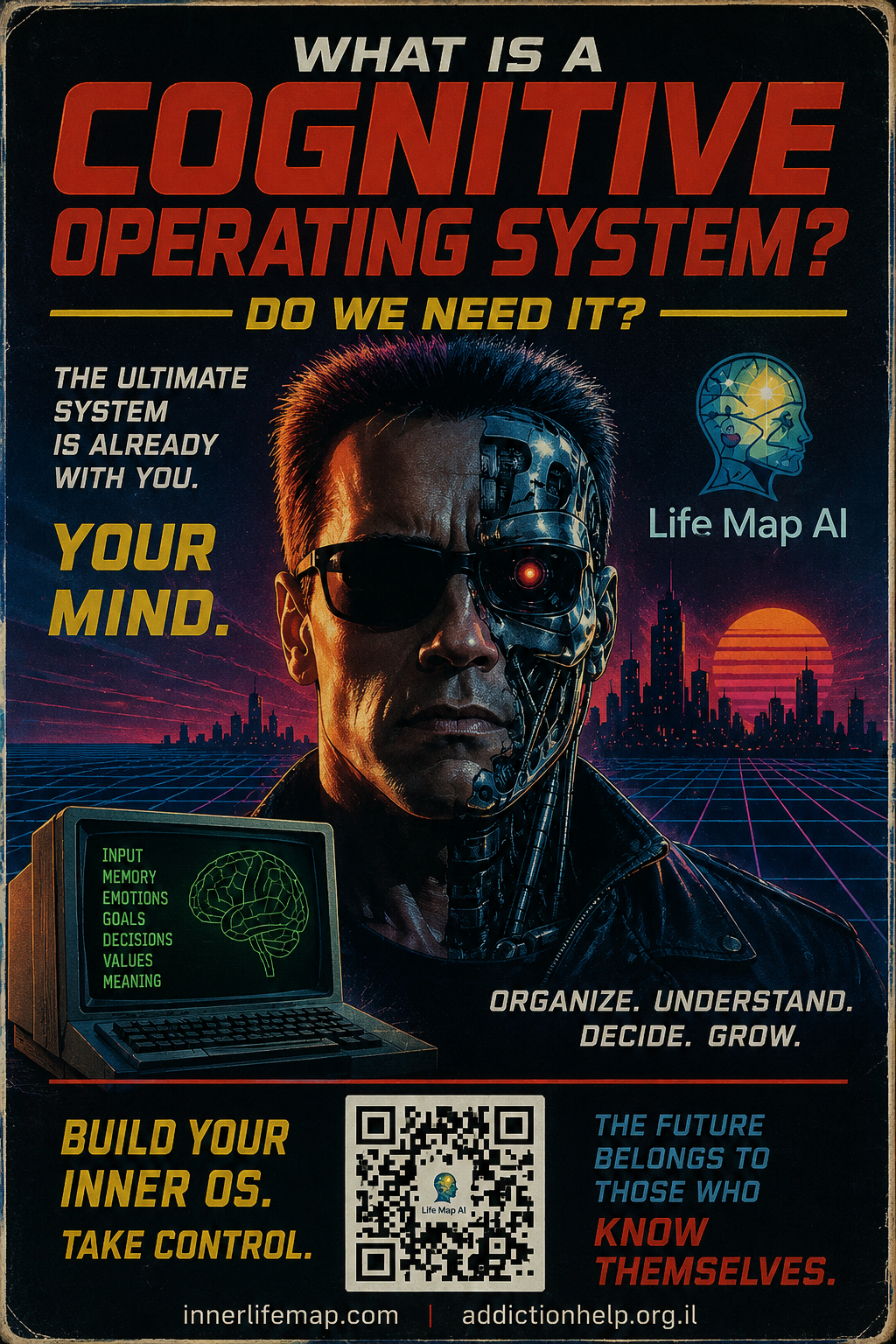
Borrowing loosely from computing, an operating system is not an application. It does not perform a single task. It manages memory, coordinates processes, exposes an interface, and gives applications a stable ground to run on. A Cognitive Operating System plays an analogous role for a human mind. It is a deliberate, external representation of the inner components that quietly shape behavior:
- Memories — the events, relationships, and experiences that continue to influence how present situations are interpreted.
- Emotions — the recurring affective patterns that color perception and choice, often below the threshold of awareness.
- Beliefs and values — the assumptions about self, others, and the world that determine what feels acceptable, safe, or worthwhile.
- Goals and priorities — the direction the person has chosen, and how that direction competes with older, unexamined commitments.
- Patterns and protocols — the repeated responses (relational, cognitive, somatic) that either serve the person or quietly work against them.
A COS makes these components legible. It turns what would otherwise remain a diffuse background hum into named, editable elements the person can look at, revisit, connect, and — when appropriate — change.
3. Why Understanding Yourself Is Becoming More Important Than AI
Three shifts, running in parallel, elevate self-understanding from a personal virtue to an infrastructural requirement.
3.1 Cognitive delegation is default
AI is quickly moving from “tool we open” to “layer we inhabit”. Search, writing, planning, learning, and increasingly emotional support all pass through models. Delegation at that scale multiplies the value of every judgment we do notdelegate — chief among them: what is actually mine to decide?
3.2 Attention is a contested resource
Recommender systems are optimized for engagement, not for a person’s coherence over time. Without an internal reference point, the loudest signal wins. A COS provides that reference point: a stable, self-authored map of what matters, against which any incoming stimulus can be compared.
3.3 The complexity of a modern life exceeds working memory
Relationships, careers, health, finances, values, and long-horizon goals are entangled in ways no unaided mind holds in one view. When there is no external representation, the person copes by narrowing focus — usually toward whatever is most urgent, not what is most important. A COS externalizes the whole, so the person can plan, reflect, and recover from the shape of their actual life, not a fragment of it.
4. What a Cognitive Operating System Is Not
- Not another chatbot. Conversation is an interface, not a substitute for structure. Talking to a model without a stable representation of self reproduces the same problem in a friendlier voice.
- Not a productivity app. Tasks are downstream of identity. A COS organizes the person, not their to-do list.
- Not therapy. A COS is a reflective infrastructure. It can support clinical work but does not replace it, and it does not pathologize normal inner life.
- Not a data lake. Storing everything is not understanding anything. The value of a COS is in what it makes visible and editable, not in the volume of data it accumulates.
5. Principles
- Human authorship. The person is the author of the map. AI may suggest, summarize, and question — never overwrite.
- Visibility before advice. A COS first helps the person see; guidance is a secondary function that only becomes safe once the picture is honest.
- Longitudinal by design. Self-knowledge is not a snapshot. A COS preserves earlier versions of the map so change becomes observable rather than rewritten by mood.
- Minimum viable structure. Impose only enough structure to make reflection possible; over-structuring collapses lived experience into a rubric.
- Reversibility. Anything the person adds, they can revise or remove. A COS strengthens agency; it does not lock in identity.
- Privacy as substrate. The reflective layer is only useful if it is safe. Ownership, portability, and the ability to forget are non-negotiable.
6. How Life Map AI Instantiates This Idea
Life Map AI is an early, deliberately narrow instantiation of a Cognitive Operating System. It uses Interactive Inner World Mapping — a visual, editable map of a person’s relationships, goals, values, fears, hopes, and significant events — as the primary interface. Where a journal is a stream and a mood tracker is a chart, an inner-world map is a place: something the person can return to, rearrange, and compare against earlier versions.
On top of that map, AI plays a strictly supportive role: it asks questions, reflects patterns, and offers structure. It does not decide who the person is. The map remains authored, edited, and owned by the human. This is not the final form of a COS. It is a research vehicle for a specific hypothesis: that visibility and structure of the inner world, sustained over time, is a more consequential lever than incremental improvements in model intelligence.
7. Open Questions
A serious COS raises questions this article does not attempt to close, but names clearly:
- Measurement. How do we know a COS is actually improving self-understanding, versus producing a confident-sounding self-narrative?
- Failure modes. Structure can calcify. When does a map help a person see themselves, and when does it start to define them?
- Integration with AI. What is the minimum interface between a personal COS and external AI systems that preserves authorship without recreating today’s data-extraction defaults?
- Equity. Reflective infrastructure must not become another privilege of the already-supported. What does a COS look like when access is a baseline, not a premium?
8. Conclusion
The interesting question of this decade is not how much more capable AI will become. It is what humans will do with the extra room that capability opens up. A Cognitive Operating System is a proposal for how to use that room deliberately: not by producing more content, more tasks, or more automated decisions, but by producing more self-knowledge that a person can act from.
In that framing, understanding yourself is not a nostalgic humanist counter-move against AI. It is the load-bearing capacity that determines whether AI ends up amplifying a person’s life or quietly overwriting it.
References (selected)
- Bruner, J. (1990). Acts of Meaning. Harvard University Press.
- Flavell, J. H. (1979). Metacognition and cognitive monitoring: A new area of cognitive–developmental inquiry. American Psychologist, 34(10), 906–911.
- Kahneman, D. (2011). Thinking, Fast and Slow. Farrar, Straus and Giroux.
- McAdams, D. P. (2001). The psychology of life stories. Review of General Psychology, 5(2), 100–122.
- Norman, D. A. (2013). The Design of Everyday Things. Basic Books.
- Pennebaker, J. W., & Smyth, J. M. (2016). Opening Up by Writing It Down. Guilford Press.
- Schön, D. A. (1983). The Reflective Practitioner. Basic Books.
- World Health Organization. (2021). Ethics and Governance of Artificial Intelligence for Health.