Anton Borts, BSW
Founder & Creator of Life Map AI
M.A. Psychology Candidate | Social Worker | Psychology Researcher
Most people speak about memory as if it were a recording device — a camera in the mind that captures what happened and plays it back on demand. This intuition is powerful, but it is wrong. Nearly a century of research in cognitive psychology and neuroscience shows that remembering is not retrieval of a stored file. It is reconstruction: the mind assembles a version of the past each time you recall it, using fragments of experience, emotion, expectation, and present understanding.
The Recording Metaphor and Why It Fails
The recording metaphor assumes memories sit somewhere intact and unchanged, waiting to be replayed. If that were true, two people remembering the same event would remember it identically, and a single person would remember it the same way at twenty as at forty. Neither is what happens. Details drift. Emotional weight shifts. The story a memory tells about you at one age is not the story it tells at another. That is not a bug in memory; it is what memory is.
Frederic Bartlett showed this in the 1930s with his classic War of the Ghosts studies: participants asked to recall a short unfamiliar story reshaped it, over time, to fit their own cultural expectations. Bartlett called the process effort after meaning. We do not simply store what happened; we make it make sense.
Reconstruction, Not Retrieval
Modern memory science treats each act of remembering as an active construction. Daniel Schacter describes memory as a constructive system whose flexibility is what allows us to imagine the future at all — the same machinery that lets you picture tomorrow is the machinery that assembles yesterday. Martin Conway's Self-Memory System frames autobiographical memories as outputs of a hierarchy that filters raw experience through current goals and identity. Nadel and Moscovitch's Multiple Trace Theory shows that recalled memories are re-encoded — subtly rewritten — every time they are brought to mind.
In other words: the act of remembering changes the thing you are remembering. Recall is not read-only.
Why Reconstruction Is Adaptive
Reconstruction is not a defect. A perfect recording of every experience would be intolerable — and, more importantly, useless for the actual work the mind is doing. Memory exists so we can act well in the present and prepare for the future, not so we can preserve the past. Compression, generalization, and recontextualization are how memory earns its keep.
The cost is that memory is porous. Elizabeth Loftus's misinformation research showed how easily post-event information — a leading question, another person's version — can be incorporated into a memory and later reported as first-hand experience. This is not lying. It is the ordinary operation of a reconstructive system doing what it evolved to do.
What Shapes a Reconstruction
Any given recollection is shaped by at least four forces working together:
- Emotion at encoding and at recall. The mood you were in when the event happened, and the mood you are in when you remember it, both bias what surfaces.
- Context. Cues in the environment — a smell, a place, a person — pull related fragments together into a coherent scene.
- Identity and self-narrative. Memories that contradict who you currently believe yourself to be are quietly edited or dropped; memories that confirm it are strengthened.
- Present knowledge. What you know now is back-projected onto what you knew then. You remember the past in the light of the future it turned out to have.
Why This Matters for Self-Understanding
If memory is reconstructive, then the story you tell about your own life is not a report — it is a working draft. That has real consequences. A single remembered failure, replayed many times, can gradually become the defining episode of an entire decade. A childhood scene revisited in adulthood can flip from “ordinary” to “formative” without the underlying event changing at all. Personal memory is closer to an ongoing interpretation than to an archive.
This is why self-understanding cannot be reduced to remembering harder. The problem is not access to a stored past; the problem is which reconstruction you keep repeating, and whether you can see it clearly enough to choose a different one.
Memory in a Cognitive Operating System
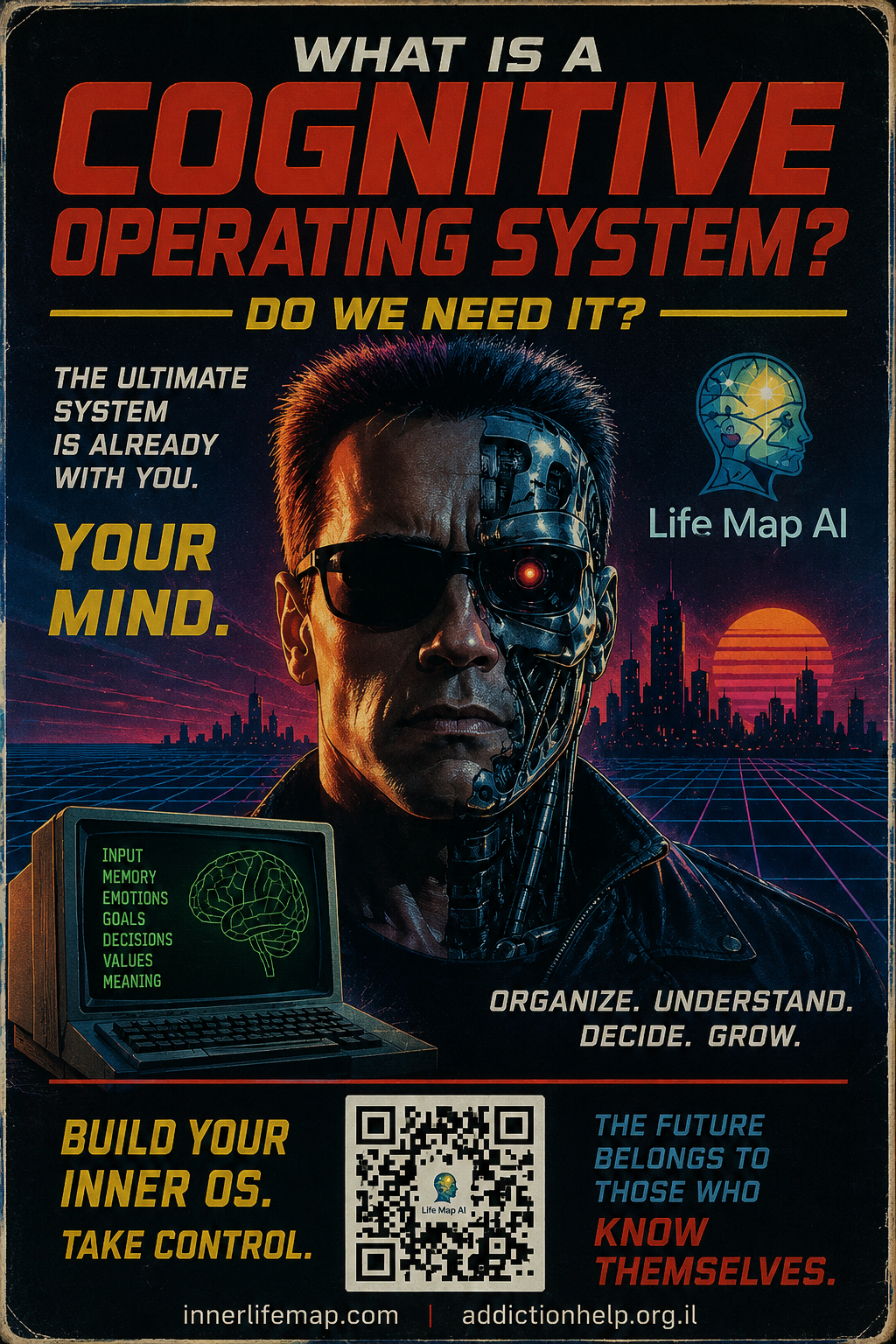
A Cognitive Operating System — the layer of self-understanding that Life Map AI is designed to support — has to take reconstructive memory seriously. If the tool treats what you write today as a fixed record of what happened, it repeats the recording metaphor at a computational scale and gets the psychology wrong.
Instead, a Cognitive Operating System represents memories as editable nodes in an inner-world map: they can be revisited, re-weighted, connected to different meanings, and marked as reinterpretations rather than facts. This is not rewriting the past. It is making the reconstructive nature of memory visible, so the person can see the difference between “what happened” and “the meaning I have been assigning to it.”
Done well, this shifts the role of AI in memory work. AI does not remember for you and does not decide what a memory means. It gives you an external surface on which your own reconstructions become inspectable — so reflection can act on them.
What to Take Away
- Memory is not a recording; it is a reconstruction.
- Each act of recall re-encodes the memory, subtly changing it.
- Emotion, context, identity, and present knowledge all shape what surfaces.
- Self-understanding is less about accurate retrieval and more about the interpretations you keep repeating.
- Tools that support self-understanding should make reconstructions visible, not treat them as archives.
References
- Bartlett, F. C. (1932). Remembering: A Study in Experimental and Social Psychology. Cambridge University Press.
- Loftus, E. F. (2005). Planting misinformation in the human mind: A 30-year investigation of the malleability of memory. Learning & Memory, 12(4), 361–366.
- Schacter, D. L., Addis, D. R., & Buckner, R. L. (2007). Remembering the past to imagine the future: The prospective brain. Nature Reviews Neuroscience, 8(9), 657–661.
- Conway, M. A., & Pleydell-Pearce, C. W. (2000). The construction of autobiographical memories in the self-memory system. Psychological Review, 107(2), 261–288.
- Nadel, L., & Moscovitch, M. (1997). Memory consolidation, retrograde amnesia and the hippocampal complex. Current Opinion in Neurobiology, 7(2), 217–227.