Inner Life Map Team
Life Map AI Publications
Visual thinking is the process of using spatial relationships, images, symbols, diagrams, and visual structure to understand information that may be difficult to hold in words alone.
Instead of processing every thought as a linear sentence, visual thinking places information into space:
- A goal can be close or distant.
- A fear can appear larger than another concern.
- Two areas of life can be connected.
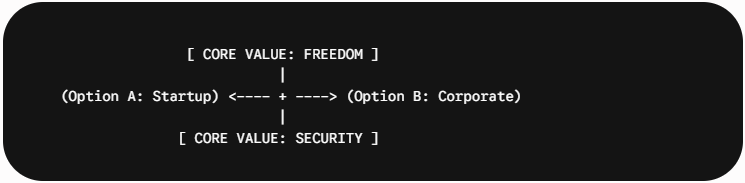
- A conflict can become visible as two competing directions.
This does not mean that the visual representation is an objective picture of the mind. It is a way of externalizing how a person currently experiences and organizes a situation.
The essential distinction: a visual map does not tell you who you are. It gives you something you can look at, question, move, compare, and reinterpret.
From Linear Thought to Spatial Thought
Traditional writing and note-taking usually unfold in a strict sequential line: one thought leads to the next, which leads to the next. Sequence is useful for arguments and instructions, but it is a poor container for situations where many factors exist at the same time and influence each other.
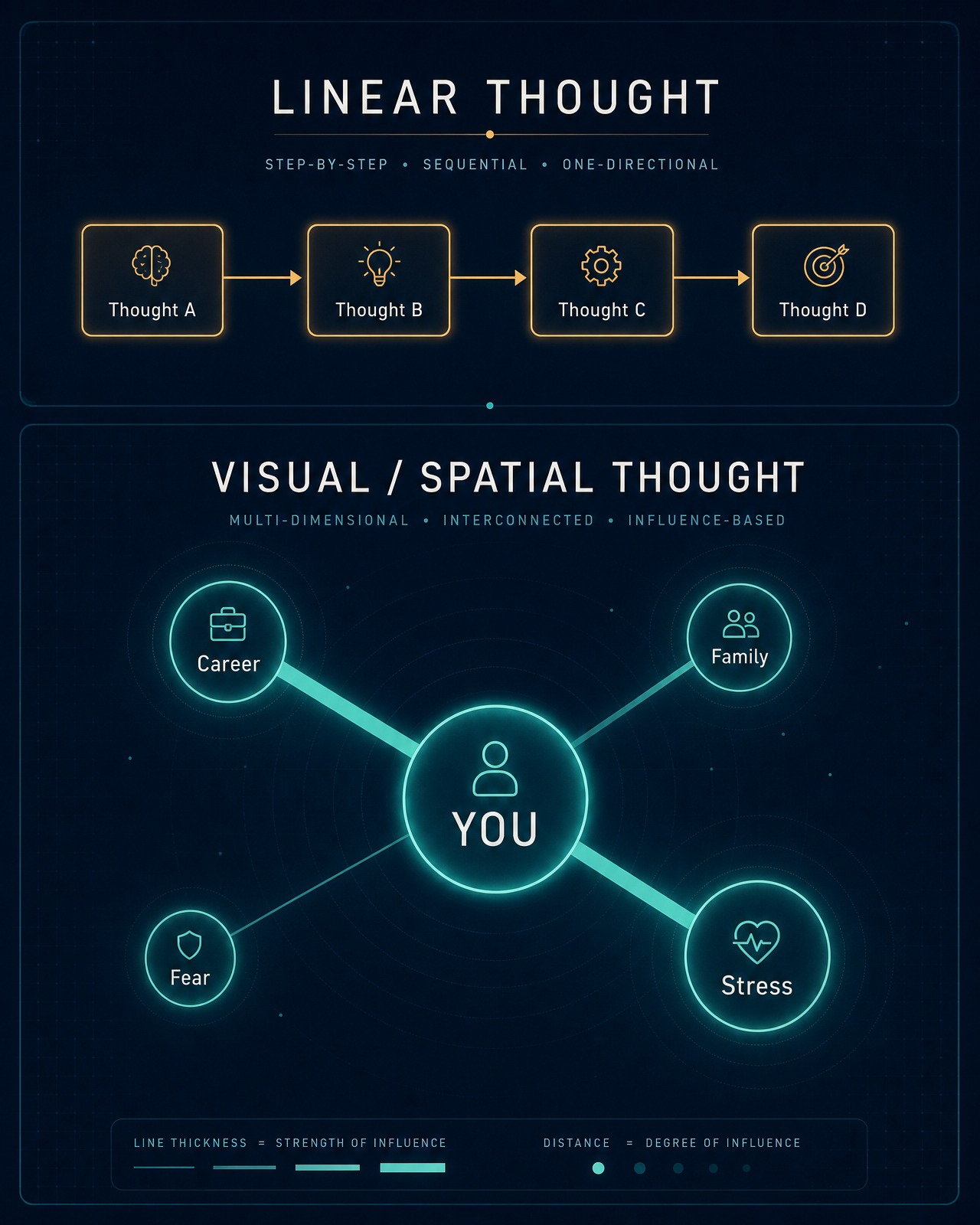
In a linear note, “career pressure”, “a difficult conversation”, and “tiredness” are three separate paragraphs. On a spatial canvas they exist simultaneously — and the space between them can carry meaning: distance, size, direction, and links.
Linear thought (sequential)
Thought A → Thought B → Thought C → Thought D. Rigid progression; difficult to grasp multi-variable complexity. Whatever came last tends to feel most important.
Visual / spatial thought (simultaneous)
A center that represents you, with elements placed around it. Distance can suggest influence, size can suggest weight, and explicit links can suggest how one element relates to another. All elements exist at once, which makes structure — rather than sequence — visible.
What Spatial Structure Can Show
1. Proximity and distance
Placing something close to the center often reflects how present it feels right now. Moving it further away is not a correction — it is a second observation that can be compared with the first.
2. Size and intensity
Size gives a non-verbal way to express weight when words feel too precise or too final. It is a description of current experience, not a measurement.
3. Links between elements
Explicit relationships — supports, drains, conflicts_with, depends_on — turn a list into a structure. Links belong to the person drawing them; nothing should be inferred on their behalf.
Visual Thinking Is Not Interpretation
A map is evidence of how a situation looks to you today. It is not a diagnosis, a personality type, or a prediction. Any reflection offered on top of a map — human or AI — should stay tentative, traceable to what is actually on the canvas, and open to being rejected by the person who made it.
This is why the useful question after making a map is rarely “what does this mean about me?”, and much more often “what do I notice, and what would I like to move?”
Where Visual Thinking Helps Most
- Personal growth: seeing several life areas at once instead of one worry at a time.
- Decision making: making two competing directions visible side by side rather than arguing them in sequence.
- Self-reflection over time: comparing the same map across weeks to notice what shifted.
- Complex, multi-variable situations: work, family, health, and energy rarely queue up politely in a line.
Try It on Your Own Situation
Place yourself at the center. Add the elements that feel present right now. Adjust distance and size until the picture looks like your current experience. Then draw only the links you actually recognize — and look at what appears.