Anton Borts, BSW
Founder & Creator of Life Map AI
M.A. Psychology Candidate | Social Worker | Psychology Researcher
We all live by hidden psychological scripts:
- “I always quit near the finish line.”
- “I can’t afford to make mistakes.”
- “My work is never enough.”
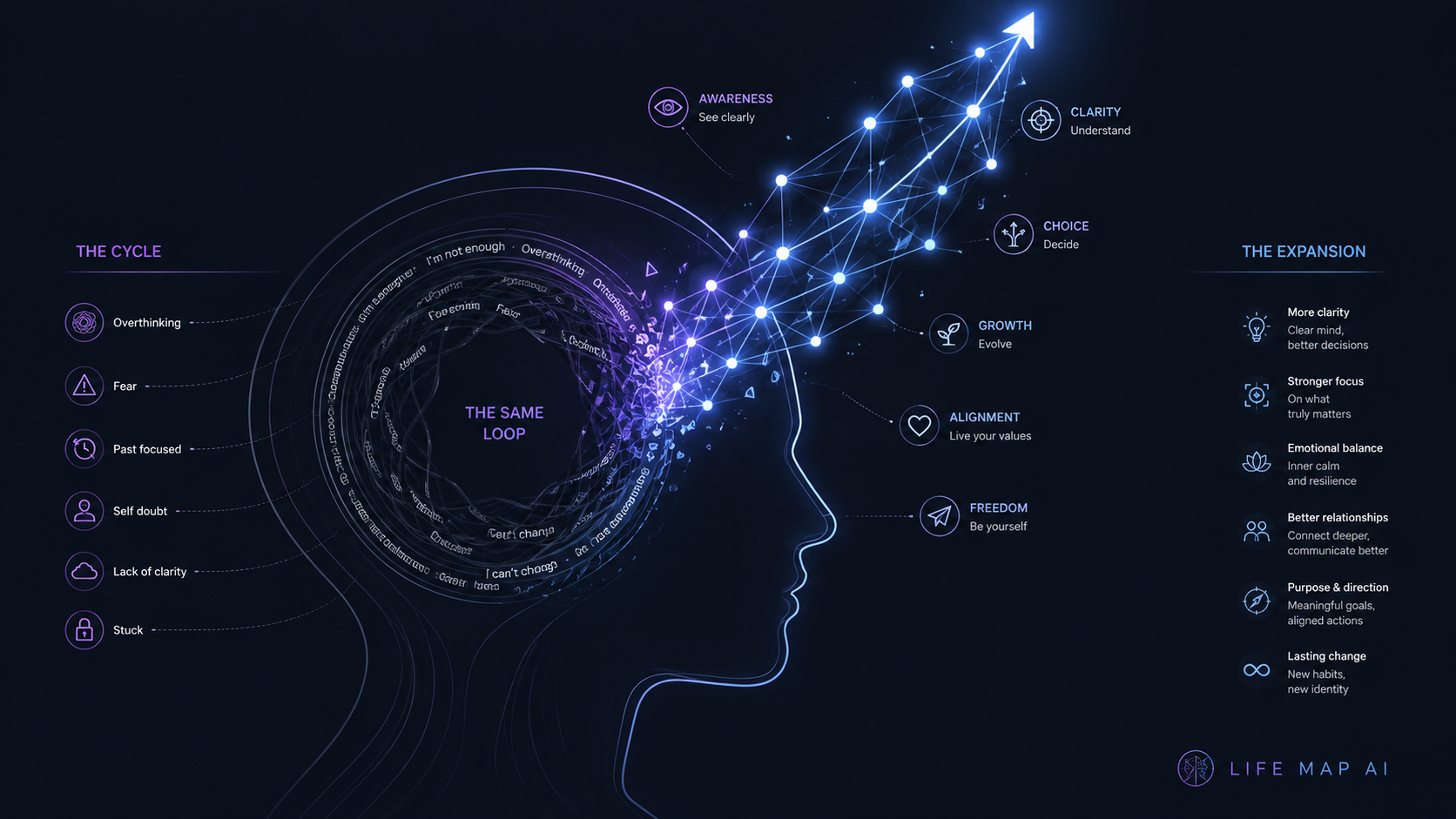
These recurring patterns form narrative loops — automatic mental tracks that shape how we respond to uncertainty, failure, and self-doubt.
When a narrative remains purely internal, we may experience what narrative-therapy authors describe as psychological fusion: we begin to treat a habitual interpretation as objective reality. The story stops feeling like something we think and starts feeling like something we are.
Spatial mapping can help interrupt this fusion through the principle of visual externalization.
The Anatomy of an Internal Loop
A narrative loop usually contains four interconnected elements.
1. The Trigger
An external event, such as:
- critical feedback;
- an approaching deadline;
- uncertainty;
- a conflict;
- a perceived mistake.
2. The Automatic Story
The instant interpretation attached to the event:
“I am failing again.”
3. The Emotional and Somatic Response
For example:
- anxiety;
- chest tightness;
- racing thoughts;
- shame;
- cognitive freeze.
4. The Habitual Action
For example:
- avoidance;
- procrastination;
- withdrawal;
- defensive overworking;
- repeated reassurance seeking.
Because this sequence can unfold within seconds, it often feels inevitable.
You cannot easily change a mechanism that you cannot clearly see.
A Simple Example
Imagine that your manager asks to speak with you for five minutes.
Trigger: Your manager asks for a conversation.
Automatic story: “I must have done something wrong.”
Emotional response: Anxiety and racing thoughts.
Habitual action: You mentally prepare to defend yourself before the conversation begins.
When this sequence is mapped visually, you may notice that the manager’s request is only the trigger. Much of the emotional reaction is produced by the story that appears immediately afterward.
Why Spatial Mapping Changes the Response
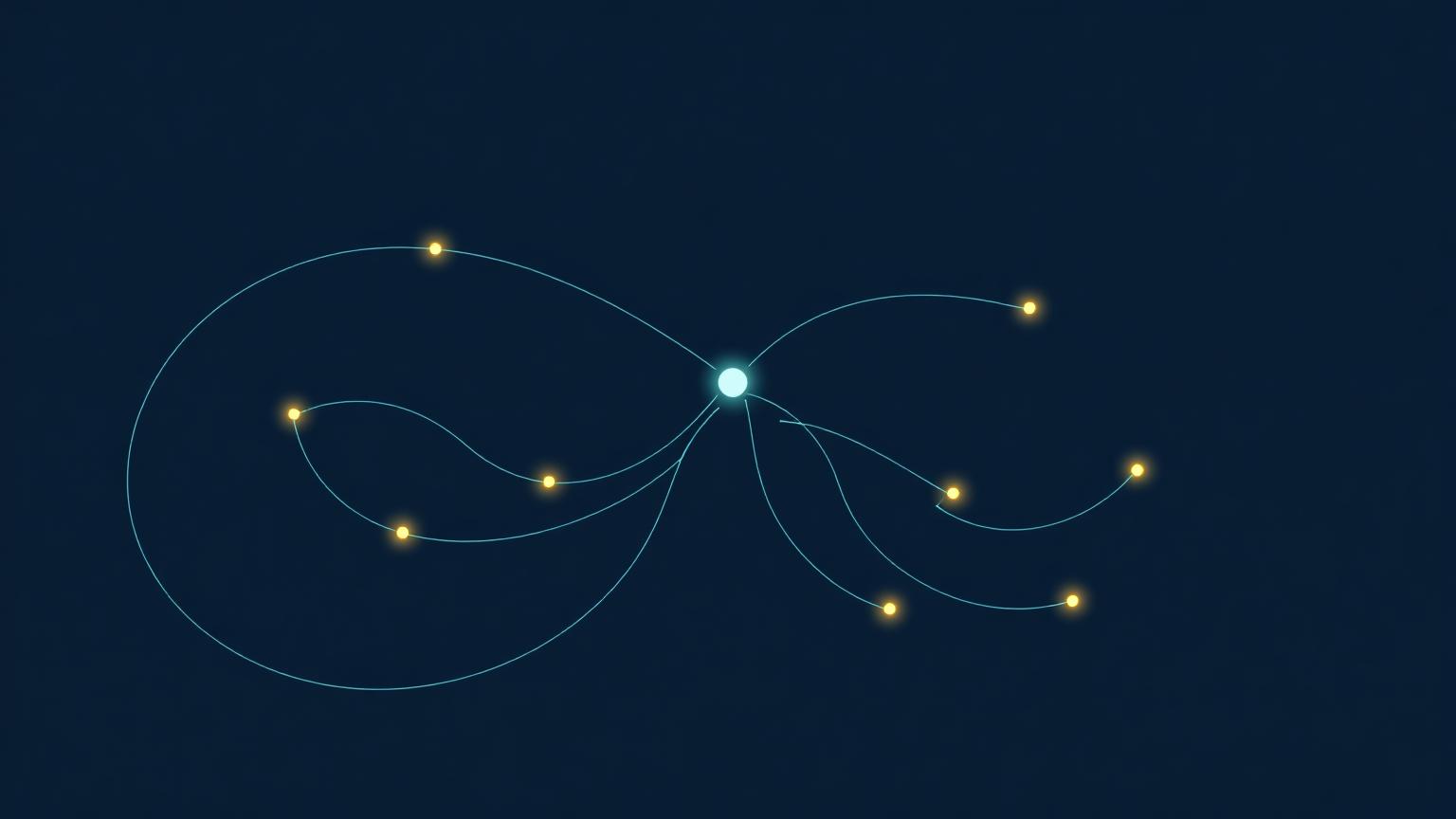
When you transfer an internal loop onto a two-dimensional canvas, such as Life Map AI, two important shifts can occur.
Self-Distancing
Research on self-distancing suggests that viewing an emotional experience from a more external perspective can reduce emotional reactivity and support more reflective processing.
Seeing your thoughts as visible nodes on a screen creates distance between:
- the event;
- the story about the event;
- the emotional response;
- the action that follows.
Structural Clarity
Internal rumination often feels linear and repetitive.
A spatial graph lets you see the entire structure at once.
It can reveal:
- where the loop begins;
- which connection reinforces it;
- where the same response repeatedly appears;
- where a new branch could be introduced.
The Three-Step Protocol to Rewrite Your Story
Use the following structure:
Trigger → Automatic Story → Habitual Response
Then create a new branch from the automatic story toward an alternative response.
Step 1. Map the Existing Loop
Place the following elements on the canvas as separate nodes:
- the trigger;
- the automatic story;
- the emotional response;
- the habitual action.
Connect them with directional links.
Add a returning connection from the habitual action back toward the trigger or story when the behavior reinforces the original belief.
This makes the closed loop visible.
Step 2. Isolate the Pivot Point
Focus on the connection between the Automatic Story and the Habitual Response.
Ask yourself:
Is this reaction the only possible continuation of this trigger?
The goal is not to deny the old story.
The goal is to see that the story and the response are two separate nodes connected by a learned pathway.
Step 3. Insert an Alternative Branch
Add a new node representing a constructive and deliberate response.
Examples:
- ask a clarifying question;
- pause before reacting;
- request more information;
- choose a smaller next step;
- tolerate uncertainty for ten minutes;
- respond according to a personal value rather than fear.
Connect the Automatic Story to this new node.
By physically drawing a new path, you shift from passive rumination toward active problem-solving.
Use Connections to Show the Loop
Life Map AI connections can help represent:
- what triggers the story;
- which emotion follows;
- which action reinforces the pattern;
- where an alternative branch can interrupt the cycle.
The user creates these links directly.
They are not diagnoses and should not be treated as objective psychological truth. They are a visual representation of how the user currently understands the pattern.
Observe Change Over Time
A narrative loop may not disappear immediately.
However, later maps may show that:
- the old story becomes smaller;
- the trigger moves farther from the center;
- the habitual response loses connections;
- a new alternative response becomes stronger;
- the loop appears less frequently.
The map history view can help users compare saved map versions and observe these structural changes over time.
The system should describe only what is visible in the saved maps and should not claim that a change proves psychological recovery.
From Passive Victim to System Architect
You do not need to forcibly suppress every old thought in order to change your relationship with it.
You can step outside the loop, view it as a structure, and design another route.
The old story may still appear.
But it no longer has to be the only path available.
Stuck in a Repeating Mental Pattern?
Do not let an old story automatically decide your next action.
Open Life Map AI, map the trigger, the story, and the habitual response — then add one alternative connection.
Your story is not fixed. Once you can see the loop, you can begin to redesign it.
References
- White, M., & Epston, D. (1990). Narrative Means to Therapeutic Ends. W. W. Norton & Company.
- Kross, E., & Ayduk, O. (2011). Making meaning out of negative experiences by self-distancing. Current Directions in Psychological Science, 20(3), 187–191.