Anton Borts
Life Map AI Research
There is often a very small moment between an impulse and an action.
Sometimes it lasts several minutes. Sometimes only a few seconds.
A person feels tension and reaches for a familiar coping behavior. Someone becomes angry and starts typing a message. Anxiety appears, and an important task is avoided. Loneliness arrives, and instead of reaching out, the person withdraws.
From the inside, these reactions can feel almost immediate:
Something happens → I react.
But psychologically, the pathway is often more complex. Between the situation and the final action there may be attention, emotion, interpretation, bodily activation, learned habits, expectations, and previous experience.
That complexity creates an important possibility:
An impulse can be real without becoming an instruction.
The goal is not to eliminate impulses. It is to make enough space to notice them before behavior becomes automatic.
Automatic reactions are not necessarily conscious decisions
Many repeated behaviors begin as useful adaptations.
Avoidance may temporarily reduce anxiety. Withdrawal may protect someone from conflict. An impulsive purchase may produce a short period of excitement or relief. Anger may create a feeling of control. Familiar coping behaviors may reduce uncomfortable internal states for a moment.
When a behavior repeatedly produces an immediate effect, it can gradually become easier to repeat.
Eventually, a familiar pathway may look like this:
Situation → Internal reaction → Familiar behavior
The person may genuinely know that another response would be better and still repeat the same behavior.
This is one reason why simply telling ourselves:
“Next time I will behave differently”
is often not enough.
Research on implementation intentions has explored precisely this gap between intention and action. Peter Gollwitzer proposed that linking a recognizable situation to a planned response — an “if X happens, then I will do Y” structure — can help people translate intentions into behavior. Later meta-analytic work found meaningful effects of such plans on goal attainment.
The important point is not that behavior can be perfectly programmed. It is that recognizing the moment in advance can change the available options when that moment actually arrives.
The pause is not suppression
A pause does not mean fighting an emotion.
It does not mean telling yourself:
“I should not feel this.”
And it does not necessarily mean forcing yourself to calm down.
A more useful interpretation is:
Pause = temporarily suspending automatic action long enough to notice what is happening.
Emotion-regulation research has long emphasized that people can influence emotional processes at multiple points rather than only trying to suppress the final response. James Gross’s process model, for example, distinguishes several possible points of regulation across the development of an emotional response, including attention, interpretation, situation modification, and response modulation.
This means that the important question may not be:
“How do I stop feeling this impulse?”
but:
“What happens if I notice the impulse before I automatically follow it?”
An urge can be observed without immediately obeying it
Mindfulness-based approaches use a related idea.
One well-known example is urge surfing: rather than trying to eliminate an urge immediately, a person observes its changing sensations and allows it to rise and fall without automatically acting on it.
A study by Sarah Bowen and Alan Marlatt examined a brief mindfulness-based urge-surfing intervention in smokers, illustrating how the relationship between urge and behavior can itself become a target of attention.
The principle is broader than any one behavior:
Experience does not have to disappear before choice becomes possible.
You can be angry and still decide not to send the message yet.
You can feel anxious and still take one small step.
You can feel lonely and still choose contact instead of withdrawal.
You can experience an impulse without pretending that the impulse is not there.
Psychological flexibility: making room for more than one response
Acceptance and Commitment Therapy describes a related process through the concept of psychological flexibility.
Rather than organizing behavior entirely around avoiding difficult thoughts and feelings, psychological flexibility involves being able to notice present experience and still act in ways that are responsive to context and personally meaningful directions.
ACT research includes processes such as acceptance, cognitive defusion, present-moment attention, values, and committed action.
For everyday self-reflection, this can be translated into a much simpler question:
“Is my first reaction my only available reaction?”
Frequently, the answer is no.
The difficulty is that alternative responses may be much less visible than the habitual one.
From impulse to choice
A simple reflection structure can therefore be useful:
Consider a few examples.
- Stress → drinking alcohol → pause → take a walk / contact someone / change environment
- Anger → send an aggressive message → pause → wait before sending / write a draft / state a boundary later
- Anxiety → avoidance → pause → take one small step / ask for support / work for ten minutes
- Loneliness → withdrawal → pause → message someone / leave the house / enter a shared space
- Impulse to buy → immediate purchase → pause → save the item / wait 24 hours / reconsider priorities
None of the alternatives is automatically “correct.”
The point is not to tell a person what they must do.
The point is to make more than one pathway visible.
This structure can be described as moving from impulse to choice.
Why visualizing the pathway may matter
Thoughts are often experienced as a continuous internal stream.
When the sequence is placed outside the mind, it becomes an object that can be inspected:
- What happened?
- What do I usually do?
- Where could a pause exist?
- What else could I choose?
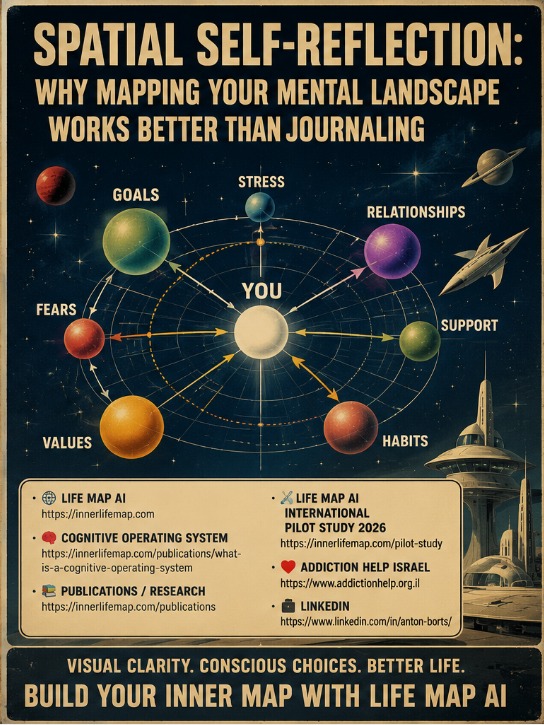
This is a form of externalization — a theme explored further in Spatial Self-Reflection.
Instead of being completely inside the reaction, a person can look at the structure of the reaction.
That distinction is subtle but important.
The pathway changes from:
“This is simply what I do.”
to:
“This is a pattern I can observe.”
And once a pattern becomes observable, it can potentially become editable.
One pattern is not the whole person
A single behavioral pathway does not explain someone’s entire inner world.
The same reaction can have very different meanings in different contexts.
Stress may involve work, relationships, finances, health, fear, expectations, identity, or several things at once.
This is where a simple impulse-to-choice exercise reaches its limit.
A pathway can show:
what happened → what I tend to do → what else I could do
but it does not automatically explain why this pattern exists, or what it means psychologically.
Those questions require wider context.
Seeing the bigger picture
This is one reason Life Map AI approaches reflection spatially — an approach described in What Is Interactive Inner World Mapping?
Instead of looking only at one reaction, a Life Map allows people to place different elements of their inner world into a broader visual field:
- people;
- goals;
- fears;
- responsibilities;
- relationships;
- values;
- conflicts;
- important life areas.
The goal is not to let an algorithm declare what these elements “really mean.”
The user remains the final interpreter.
The map simply makes relationships easier to inspect.
A repeated reaction may then become part of a larger question:
“What else is happening around this pattern in my life?”
The aim is not perfect control
Human behavior is not a machine.
There will always be moments when reactions are fast, emotional, contradictory, or difficult to understand.
The goal of reflective tools should therefore not be perfect behavioral control.
A more realistic goal is:
to notice more, react slightly less automatically, and preserve the possibility of choice.
Sometimes the difference between repeating a familiar pattern and trying something different begins with something remarkably small:
a pause.
References
- Bowen, S., & Marlatt, A. (2009). Surfing the urge: Brief mindfulness-based intervention for college student smokers. Psychology of Addictive Behaviors, 23(4), 666–671. https://doi.org/10.1037/a0017127
- Gollwitzer, P. M. (1999). Implementation intentions: Strong effects of simple plans. American Psychologist, 54(7), 493–503. https://doi.org/10.1037/0003-066X.54.7.493
- Gollwitzer, P. M., & Sheeran, P. (2006). Implementation intentions and goal achievement: A meta-analysis of effects and processes. Advances in Experimental Social Psychology, 38, 69–119. https://doi.org/10.1016/S0065-2601(06)38002-1
- Gross, J. J. (1998). The emerging field of emotion regulation: An integrative review. Review of General Psychology, 2(3), 271–299. https://doi.org/10.1037/1089-2680.2.3.271
- Hayes, S. C. (2019). Acceptance and commitment therapy: Towards a unified model of behavior change. World Psychiatry, 18(2), 226–227. https://doi.org/10.1002/wps.20626