Inner Life Map Team
Life Map AI Publications
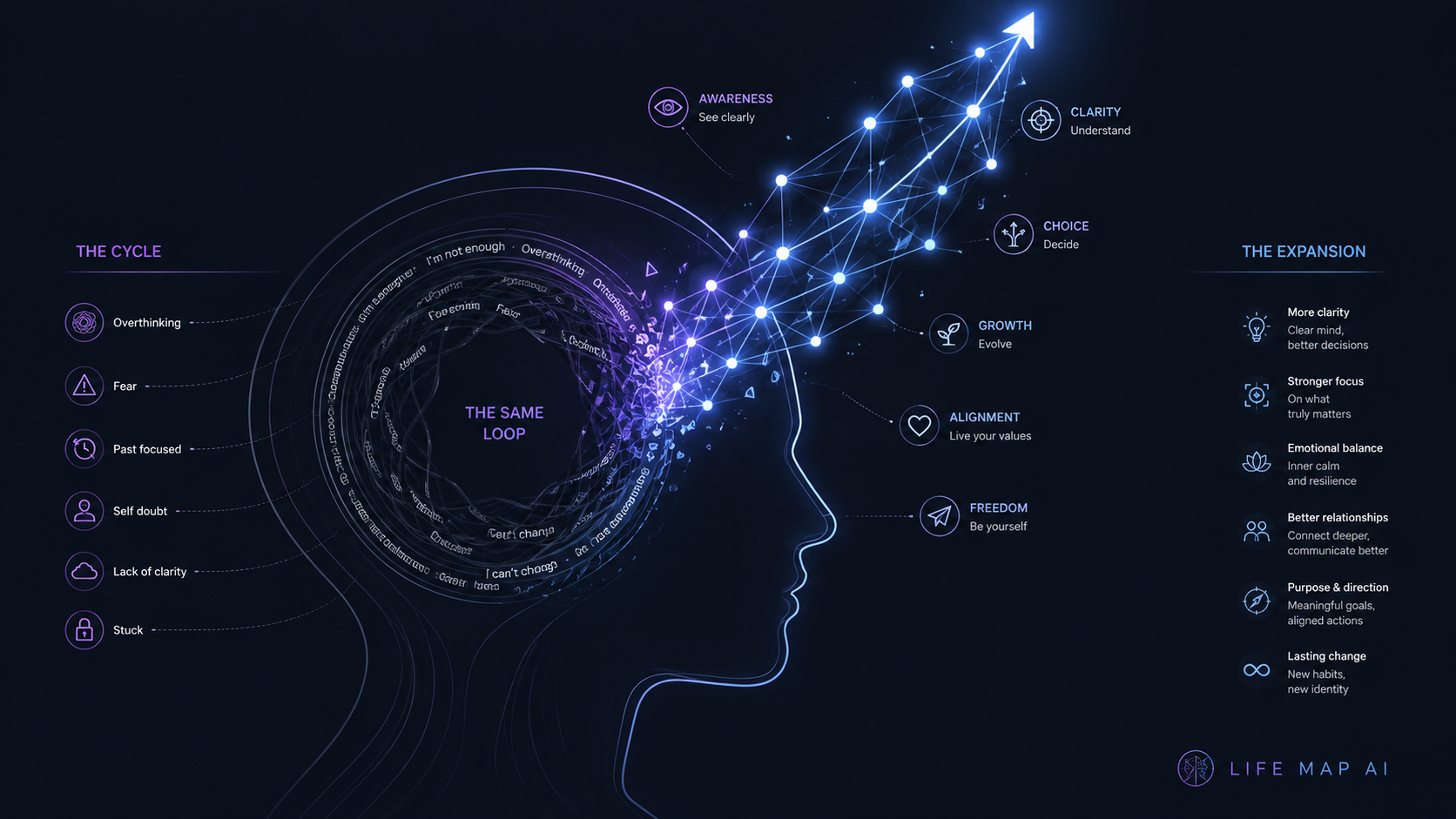
When you process stress, burnout, or complex life decisions purely in your head or through traditional stream-of-consciousness journaling, your mind operates in a linear sequence. One anxious thought triggers the next, creating a closed, repetitive loop.
Cognitive science and art therapy show that spatial externalization completely transforms how the brain processes inner states.
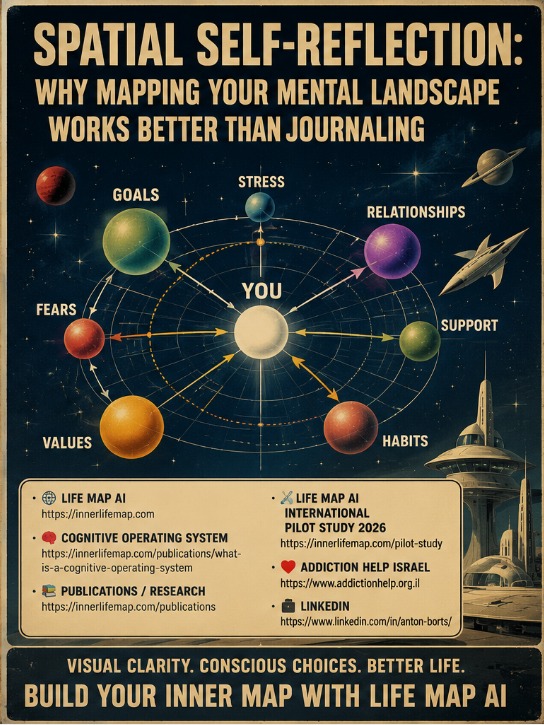
By converting vague internal feelings into distinct visual nodes on a two-dimensional canvas — where distance from the center represents immediate influence, and node size reflects energy — you move from emotional reaction to systemic clarity.
The 3 Mechanics of Spatial Mapping
1. Visual Self-Distancing
When you place a thought, fear, or goal on a screen, research in self-distancing (Kross & Ayduk, 2011) shows an immediate drop in amygdala reactivity. You stop identifying with the emotion (“I am overwhelmed”) and begin observing it as an external object (“There is a high-intensity stressor located near my core”).
2. Revealing Hidden Connections
A linear text note hides structural relationships. On an interactive spatial canvas, drawing explicit directional links (supports, drains, conflicts_with) reveals the systemic root of your fatigue. You quickly see which resources are sustaining you and which nodes are silently draining your energy.
3. Spatial Prioritization
Placing core priorities close to your center (the “Me” axis) while pushing peripheral distractions toward the edges gives your working memory an instant visual hierarchy. You shift from chaotic multi-tasking to deliberate boundary-setting.
How to Map Your Current State in 3 Minutes
- Place Your Anchor Points: Start by positioning your current primary state at the center of your canvas.
- Add Surrounding Factors: Map key life domains, stressors, and emotional drivers as surrounding nodes. Adjust their size, energy level, and distance based on their current weight.
- Connect the System: Draw relationships between nodes — identify what fuels you and what creates friction.
By stepping outside the mental noise, you stop reacting to automatic scripts and start architecting intentional choices.
Ready to Gain Visual Clarity on Your Current Life Season?
Open Life Map AI, map your inner landscape spatially, and receive a gentle, non-diagnostic reflection to help you navigate your next step.
References
- Kross, E., & Ayduk, O. (2011). Making sense of red experiences: Self-distancing as a mechanism facilitating adaptive self-reflection. Psychological Science, 22(8), 997–1002.
- White, M., & Epston, D. (1990). Narrative Means to Therapeutic Ends. W. W. Norton & Company.