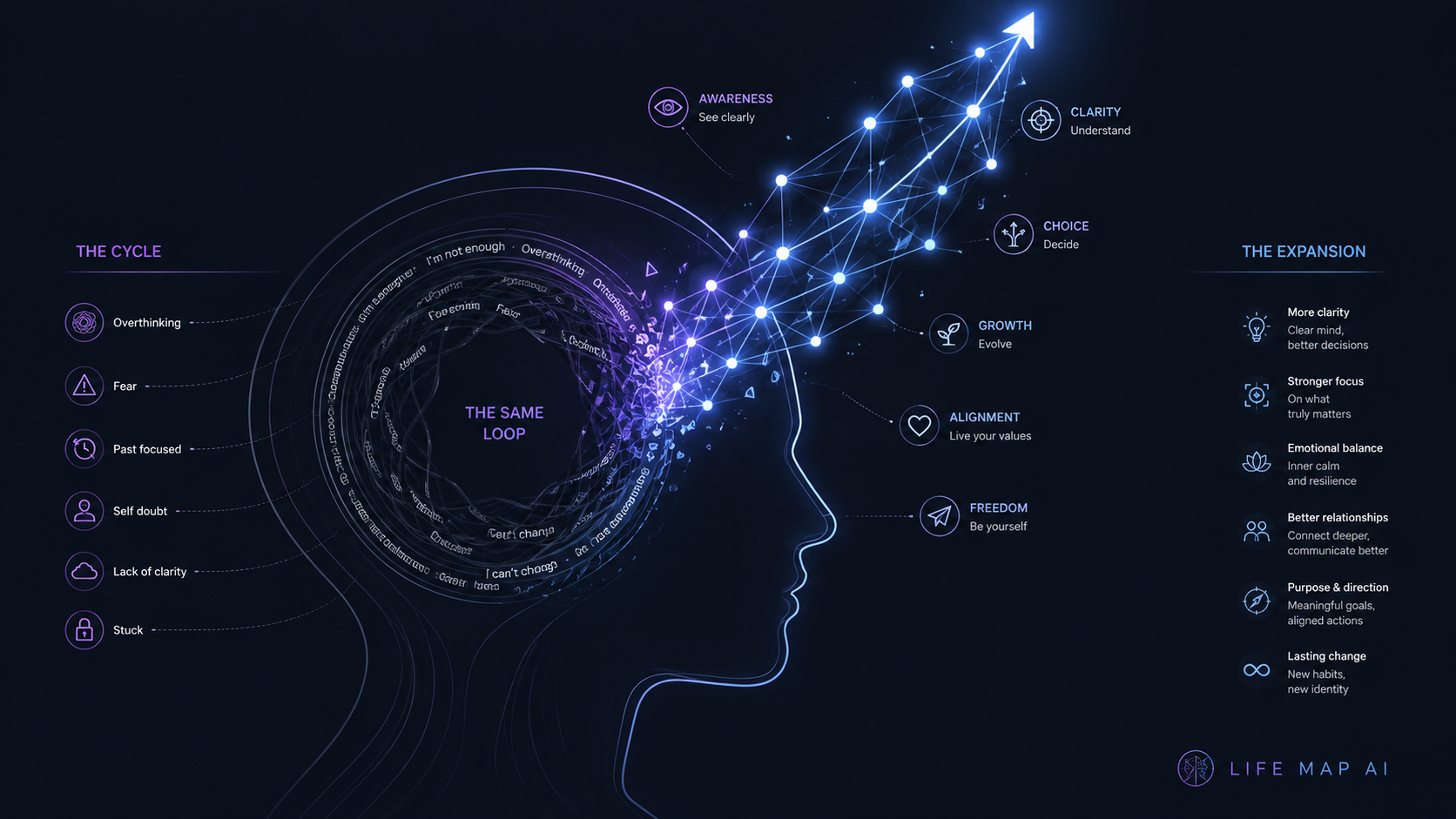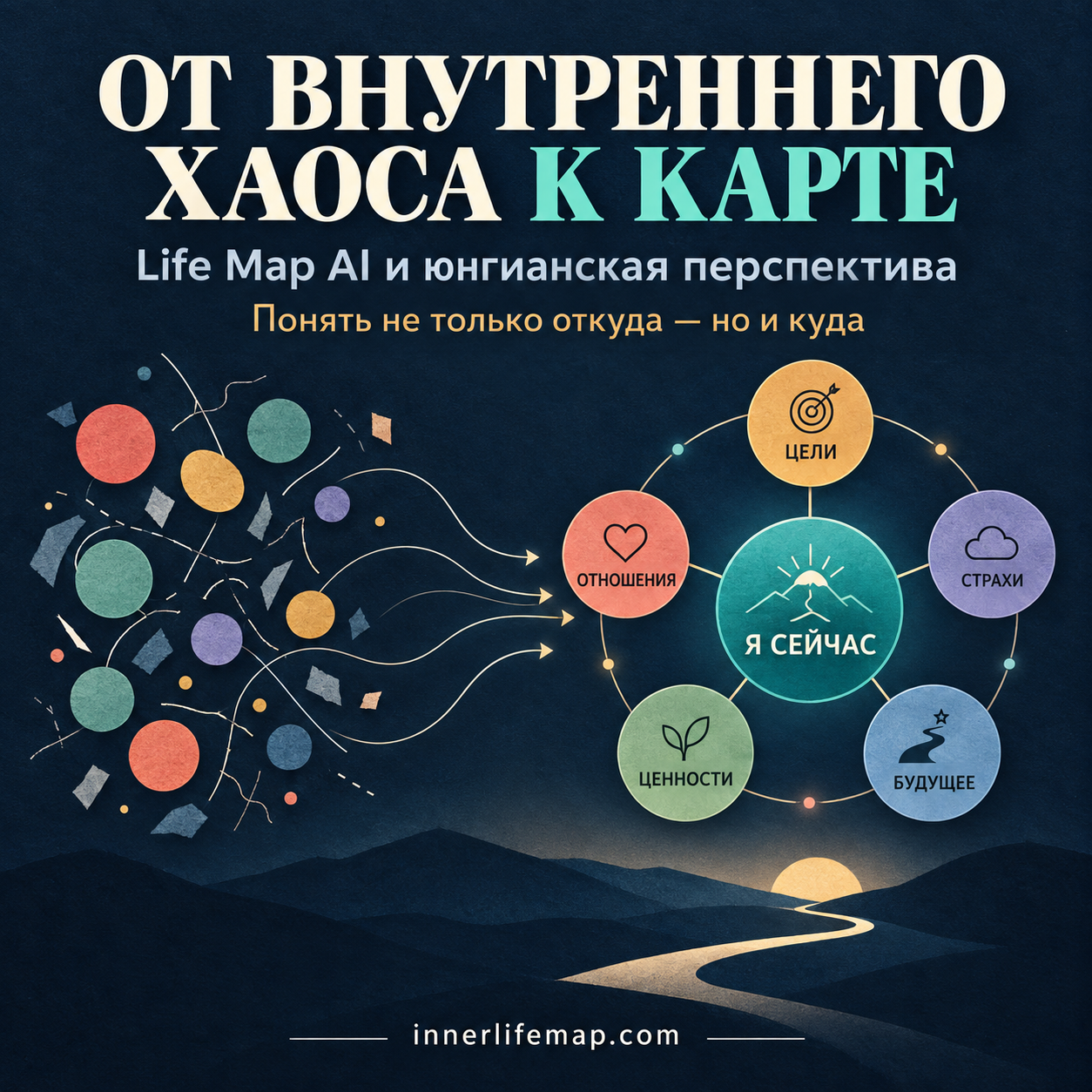
The Jungian approach invites us to ask not only, "Why is this happening to me?" but also, "Where is this leading me?" It is a shift from explanation to orientation: from looking backward for a cause to looking forward for a direction.
Life Map AI helps us represent the inner world as a visual map. Significant relationships, emotions, fears, values, and goals become visible objects that can be arranged, connected, and reconsidered. In this form, it is easier to notice hidden links and to ask which part of ourselves we have not yet acknowledged or do not see.
What AI does — and does not do
AI does not determine the meaning of the map in place of the person. It does not interpret dreams, assign labels, or offer diagnoses. Its role is more modest and, in many ways, more useful: it helps us look more carefully at our own inner picture and formulate questions that might otherwise remain vague.
Five questions the map invites
When the inner world is externalized as a map, reflection becomes spatial. The questions that naturally arise are:
- What is missing from my map?
- What is taking up too much space?
- What do I want to bring closer?
- What kind of person am I becoming?
- Where is the current structure of my life leading me?
Seeing the whole story
Sometimes we do not need yet another explanation of our own story. We need the opportunity to see it as a whole — and to choose the next conscious step. A map does not decide for us. It simply gives the inner landscape a shape we can look at, revise, and return to.