Anton Borts
Life Map AI Publications
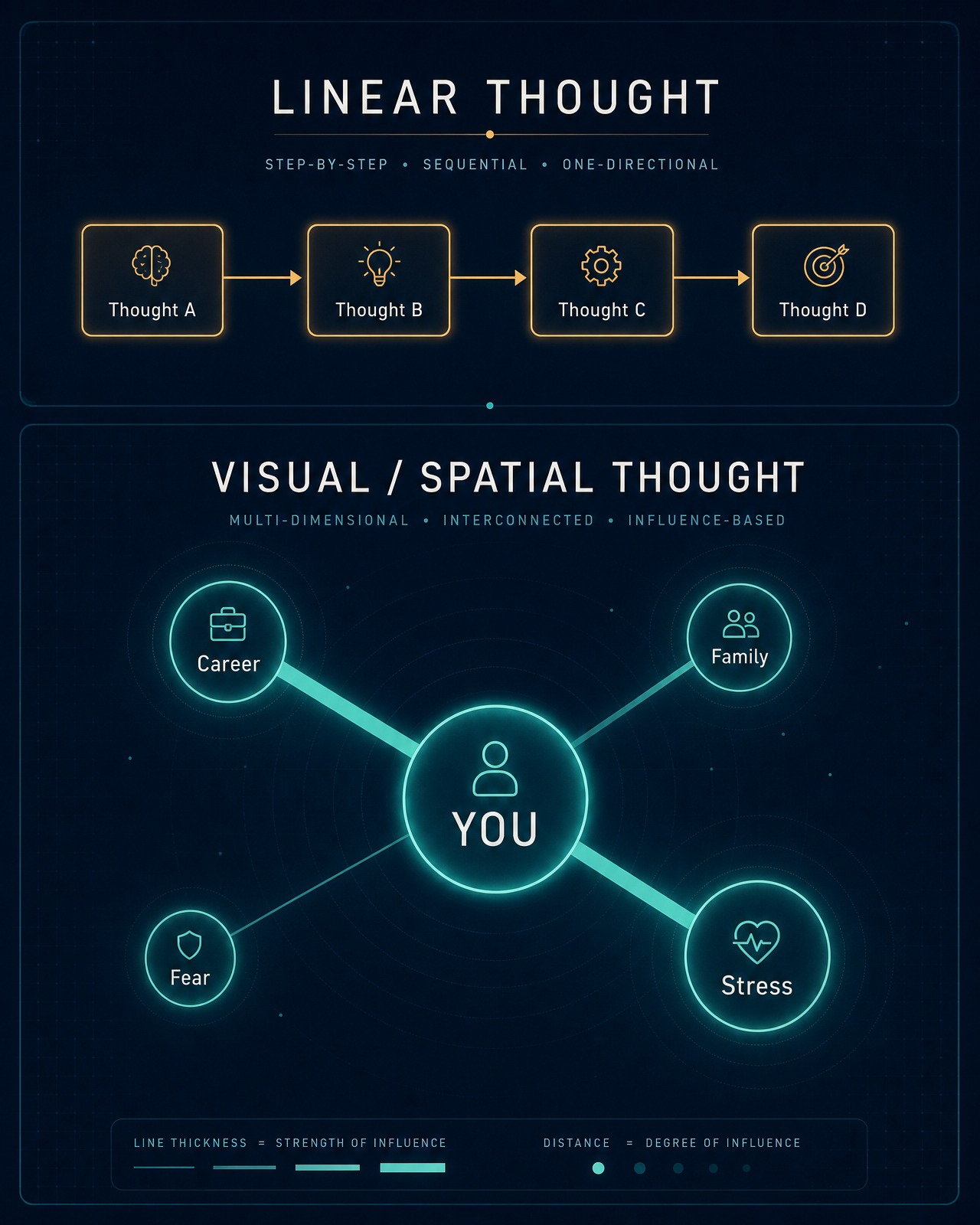
We are used to thinking in words. We write notes, make lists, describe problems, and organize ideas through sentences. This linear form of thinking is extremely powerful, but it has an important limitation: information must be processed one element after another.
Human life rarely works that way.
Our goals, relationships, fears, responsibilities, memories, values, and expectations exist simultaneously. A difficult decision about work, for example, may involve financial security, family, ambition, identity, fear of change, and future possibilities at the same time. Visual thinking offers another way to approach this complexity: instead of describing every element sequentially, we can place information into space and observe relationships between its parts.
From Words to Space
Visual thinking is much more than thinking in pictures. It can involve diagrams, symbols, spatial relationships, distance, size, position, grouping, and connections.
When information becomes spatial, different questions become possible. What is close to what? Which elements form a cluster? What appears unusually large or important? Which factors conflict? What has moved or changed over time?
External representations such as diagrams and maps can also become part of the thinking process itself. Sometimes we do not create a diagram because we already understand something — we understand it better because we created the diagram. A related discussion appears in Visual Thinking: Seeing Complexity Instead of Fighting It.
This principle has implications far beyond education or business.
Visual Thinking and the Inner World
The same approach can be applied to self-reflection.
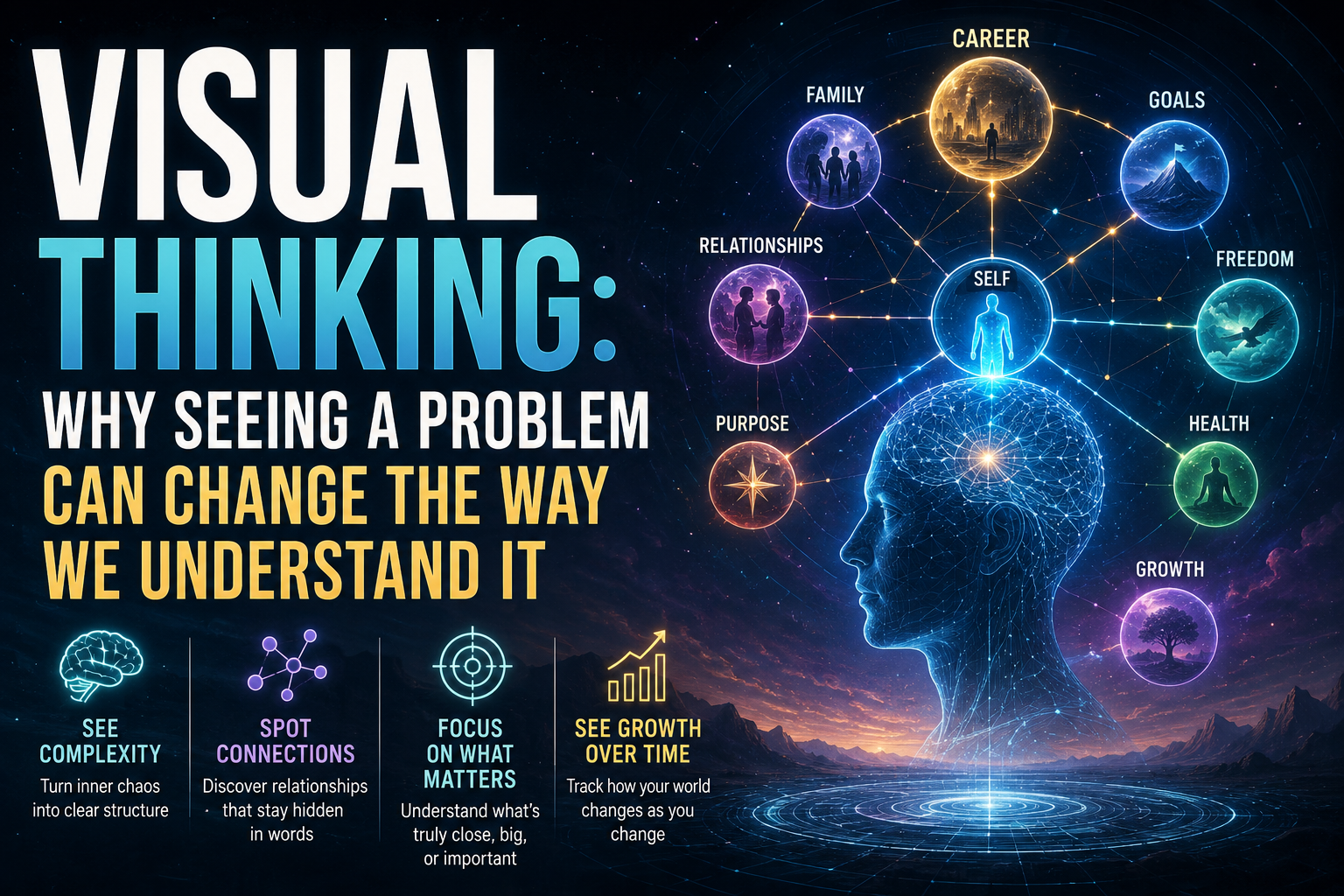
Imagine representing important parts of your current life on a spatial map: family, work, health, relationships, fears, goals, hopes, identity, or future plans. Instead of writing about each separately, you can see them together — an idea explored further in Spatial Self-Reflection.
A goal might feel close to the Self. A fear might occupy a surprisingly large space. Family could be connected simultaneously with support and responsibility. Something that once seemed central might gradually move toward the periphery.
The map does not objectively reveal what is happening inside the mind, and spatial position should never automatically be treated as a psychological diagnosis. Its value is different: it gives a person an external representation that can be observed, questioned, changed, and interpreted. When competing directions are involved, the same logic applies to choices, as described in The Decision Map.
This idea forms part of the conceptual foundation of Life Map AI — an interactive environment where people can visually organize meaningful elements of their inner world and observe how their subjective map changes over time, through visual reflection and the time machine view.
Why Visual Thinking Matters in the Age of AI
Artificial intelligence can already generate text, summarize information, compare alternatives, and suggest possible solutions within seconds. As these capabilities improve, simply producing more information may become less valuable than understanding how information is structured.
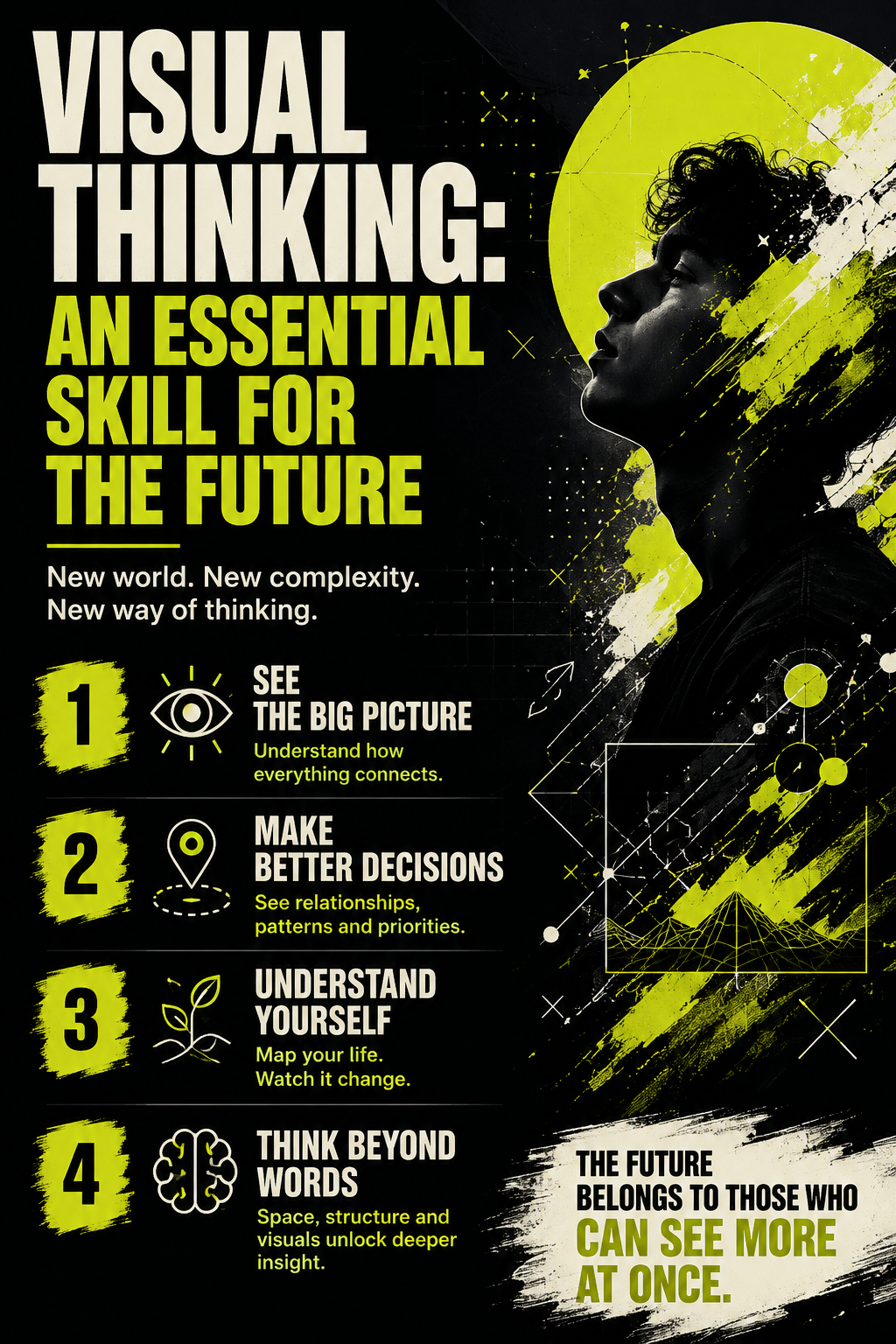
The important human skill may increasingly become the ability to see relationships, recognize patterns, distinguish what matters, and ask better questions.
This is where visual thinking becomes particularly interesting.
AI can help us process information. Spatial representations can help us see complexity. But the person remains responsible for interpretation and meaning — a principle discussed in What Is a Cognitive Operating System?
The future may therefore belong not to one form of thinking, but to a combination of language, visual structure, spatial reasoning, and artificial intelligence.
Visual thinking will not replace words. It may become an increasingly important complement to them — especially when the problem is too complex to fit comfortably into a linear sequence.
The future of thinking may not be about thinking faster. It may be about learning to see more at once.