Anton Borts, BSW
Founder & Creator of Life Map AI
M.A. Psychology Candidate | Social Worker | Psychology Researcher
Abstract
A Cognitive Operating System (COS) is proposed as a new layer for human self-understanding in the age of artificial intelligence. Rather than automating thought, a COS supports it: it makes the memories, emotions, beliefs, values and behavioral patterns that quietly shape a person’s life visible, editable, and revisitable over time. This article defines the concept, situates it within established psychological traditions (Kahneman’s dual-process theory, Bandura’s self-efficacy, Dweck’s mindset research, Hayes’ psychological flexibility, and Frankl’s meaning-based framework), and describes how Life Map AI operationalizes the idea through Interactive Inner World Mapping.
1. Why a New Layer Is Needed
Contemporary AI systems accelerate what a person can do, but they do not strengthen what a person can see about themselves. Recommendation engines, chat assistants, and productivity tools optimize for output — the finished email, the summarized document, the completed task. None of them help a person answer the harder, older questions: What actually matters to me right now? Which of my beliefs are still mine? Which patterns are running me?
The gap between capability outside the person and clarity inside the person is the space a Cognitive Operating System is designed to occupy.
2. Definition
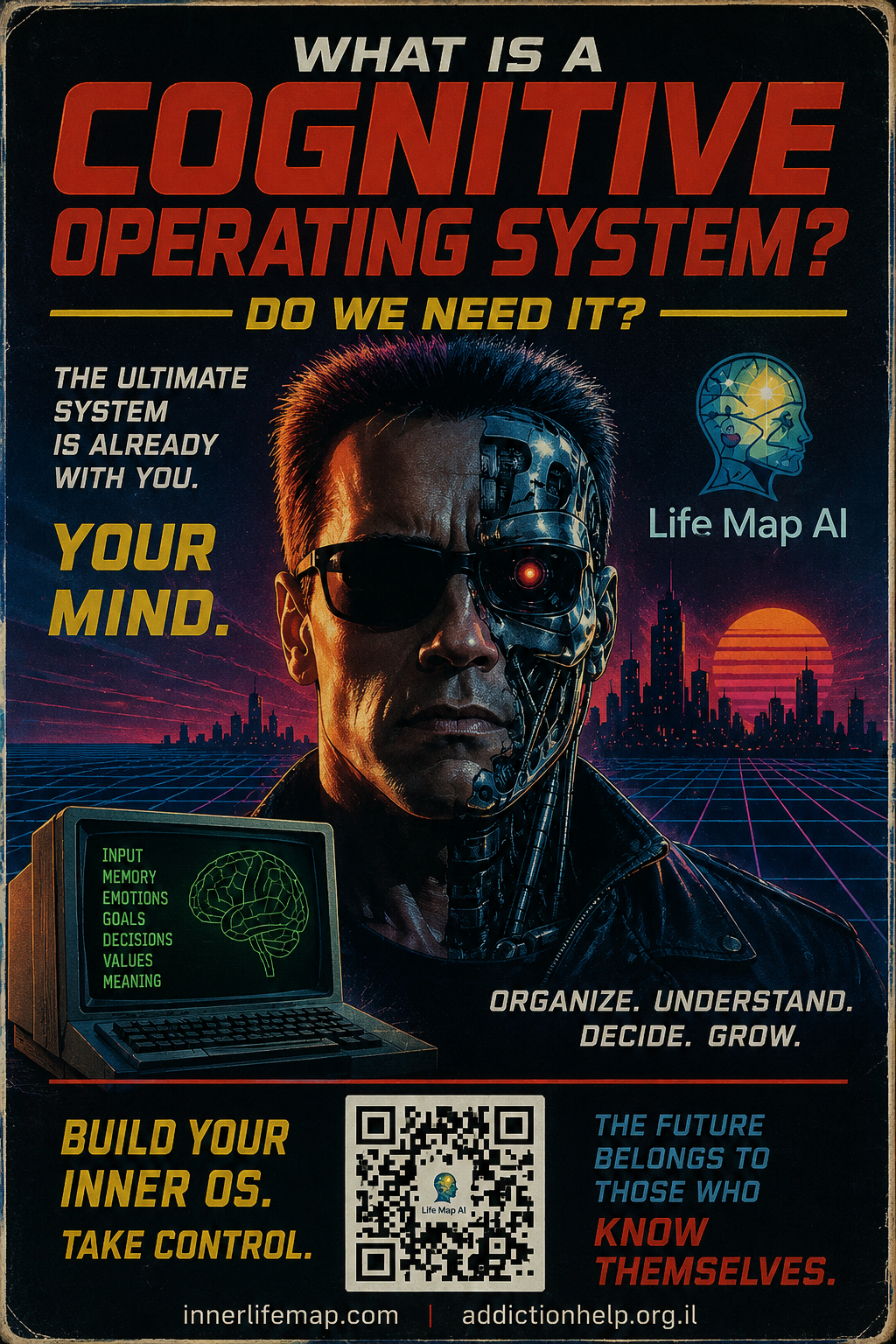
A Cognitive Operating System is an editable, longitudinal representation of a person’s inner world — memories, emotions, beliefs, values, goals, relationships and behavioral patterns — that a person can observe, revise, and act from over time.
The word “operating system” is deliberate. A COS is not an application. It does not perform a single task. It is the underlying structure that lets other parts of life — relationships, work, health, use of AI — run more coherently because the person running them has a stable view of themselves.
3. The Five Components
A COS organizes inner life into five components. These are not clinical categories; they are practical handles for reflection.
- Memories. Formative events and ongoing experiences that continue to shape how present situations are interpreted.
- Emotions. Recurring affective patterns — what tends to arrive, around what, and how it moves through the body.
- Beliefs & values. The often-unspoken assumptions about self, others, and the world that determine what feels acceptable, safe, or worthwhile.
- Goals & relationships. The direction a person has chosen and the people the direction is being lived with, against, or beside.
- Patterns & protocols. Repeated responses — relational, cognitive, somatic — that either serve the person or quietly work against them.
4. Psychological Foundations
4.1 Dual-process reasoning (Kahneman)
Kahneman’s System 1 / System 2 distinction shows that most daily decisions are made fast, associatively, and outside deliberate awareness. A COS gives System 2 a place to stand: an external, low-effort surface for reviewing what System 1 has already committed the person to.
4.2 Self-efficacy (Bandura)
Bandura’s work on self-efficacy demonstrates that belief in one’s capacity to act is itself causal. A COS supports self-efficacy by making change observable — earlier versions of the inner map are preserved, so growth stops being a story the person has to trust and becomes something they can compare.
4.3 Mindset (Dweck)
Dweck’s research on growth versus fixed mindsets shows that identity is more plastic than most people assume, but only when the person can see themselves as editable. A COS is edit-first by design: everything the person adds, they can revise or remove.
4.4 Psychological flexibility (Hayes)
Hayes and colleagues describe psychological flexibility as the ability to contact the present moment, hold internal experience without fusion, and act in line with chosen values. A COS operationalizes this: it externalizes internal experience so it can be looked at rather than merged with, and it keeps values visible next to day-to-day choices.
4.5 Meaning (Frankl)
Frankl’s central claim — that meaning is not given, but constructed — implies a substrate on which construction happens. A COS is that substrate: a place where a person’s meaning-making becomes durable enough to be revisited, refined, and lived from.
5. What a COS Is Not
- Not another chatbot. Conversation is an interface; a COS is a structure. Talking to a model without a stable representation of self reproduces the same problem in a friendlier voice.
- Not a productivity app. Tasks are downstream of identity. A COS organizes the person, not their to-do list.
- Not therapy. A COS can support clinical work but does not replace it, and it does not pathologize normal inner life.
- Not a data lake. Storing everything is not understanding anything. The value of a COS is in what it makes visible and editable, not in the volume of data it accumulates.
- Not built for the person by the machine. A COS is built with the person. The human is the author of the map; AI assists.
6. Design Principles
- Human authorship. The person is the author. AI may suggest, summarize, and question — never overwrite.
- Visibility before advice. A COS first helps a person see; guidance is a secondary function that only becomes safe once the picture is honest.
- Longitudinal by design. Self-knowledge is not a snapshot. Earlier versions of the map are preserved so change becomes observable rather than rewritten by mood.
- Minimum viable structure. Impose only enough structure to make reflection possible; over-structuring collapses lived experience into a rubric.
- Reversibility. Anything the person adds, they can revise or remove. A COS strengthens agency; it does not lock in identity.
- Privacy as substrate. The reflective layer is only useful if it is safe. Ownership, portability, and the ability to forget are non-negotiable.
7. How Life Map AI Instantiates the Idea
Life Map AI is an early, deliberately narrow instantiation of a Cognitive Operating System. Its primary interface is Interactive Inner World Mapping: a visual, editable map of relationships, goals, values, fears, hopes, and significant events. Where a journal is a stream and a mood tracker is a chart, an inner-world map is a place — something the person can return to, rearrange, and compare against earlier versions.
On top of that map, AI plays a strictly supportive role: it asks questions, reflects patterns, and offers structure. It does not decide who the person is. The map remains authored, edited, and owned by the human.
8. Open Questions
- Measurement. How do we know a COS is actually improving self-understanding, rather than producing a confident-sounding self-narrative?
- Failure modes. Structure can calcify. When does a map help a person see themselves, and when does it start to define them?
- Integration with AI. What is the minimum interface between a personal COS and external AI systems that preserves authorship without recreating today’s data-extraction defaults?
- Equity. Reflective infrastructure must not become another privilege of the already-supported. What does a COS look like when access is a baseline, not a premium?
9. Conclusion
A Cognitive Operating System is not a smarter AI. It is a slower, human-side layer that turns inner life from a diffuse background hum into something a person can look at, edit, and act from. As machines get better at doing on our behalf, this capacity — seeing ourselves clearly enough to remain the author of our own lives — becomes the scarcer and more consequential one.
References (selected)
- Bandura, A. (1997). Self-Efficacy: The Exercise of Control. W. H. Freeman.
- Dweck, C. S. (2006). Mindset: The New Psychology of Success. Random House.
- Frankl, V. E. (1959). Man’s Search for Meaning. Beacon Press.
- Hayes, S. C., Strosahl, K. D., & Wilson, K. G. (2011). Acceptance and Commitment Therapy: The Process and Practice of Mindful Change (2nd ed.). Guilford Press.
- Kahneman, D. (2011). Thinking, Fast and Slow. Farrar, Straus and Giroux.
- McAdams, D. P. (2001). The psychology of life stories. Review of General Psychology, 5(2), 100–122.
- Norman, D. A. (2013). The Design of Everyday Things. Basic Books.
- Pennebaker, J. W., & Smyth, J. M. (2016). Opening Up by Writing It Down. Guilford Press.