Life Map AI
Назад к публикациям
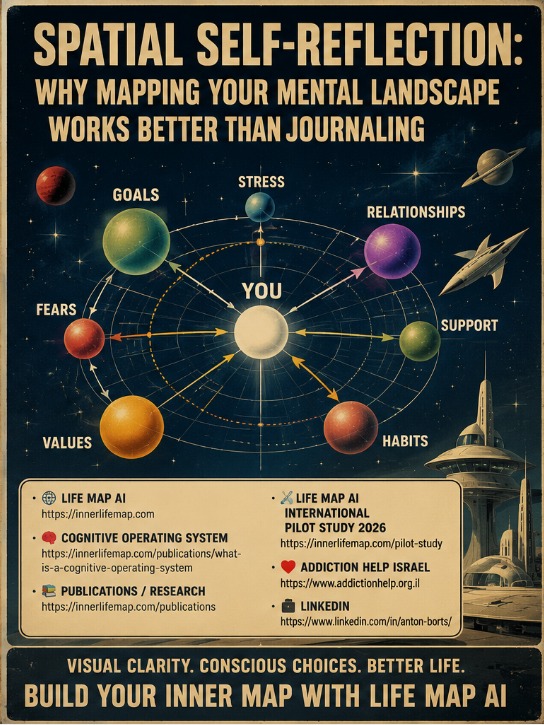
Retro space-age poster showing a radial inner-world map: YOU at the center with orbiting nodes for goals, stress, relationships, support, habits, values, and fears.
Опубликовано 4 мин чтения

Spatial Self-Reflection: Why Mapping Your Mental Landscape Works Better Than Journaling

How spatial externalization transforms the way the brain processes stress, burnout, and internal states

Inner Life Map Team · 2026 · Life Map AI Publications

Информация о публикации

Опубликовано
Обновлено
DOI
Ожидается
Статус
Опубликовано
Язык
Английский

Аннотация

Discover how spatial externalization transforms how the brain processes stress, burnout, and internal states compared to linear journaling.

Ключевые слова

  • Spatial Self-Reflection
  • Spatial Mapping
  • Visual Externalization
  • Self-Distancing
  • Journaling
  • Cognitive Psychology
  • Life Map AI

This article is currently available in English only. A translated version is planned. The full text below is presented in English.

Inner Life Map Team
Life Map AI Publications

When you process stress, burnout, or complex life decisions purely in your head or through traditional stream-of-consciousness journaling, your mind operates in a linear sequence. One anxious thought triggers the next, creating a closed, repetitive loop.

Cognitive science and art therapy show that spatial externalization completely transforms how the brain processes inner states.

By converting vague internal feelings into distinct visual nodes on a two-dimensional canvas — where distance from the center represents immediate influence, and node size reflects energy — you move from emotional reaction to systemic clarity.

The 3 Mechanics of Spatial Mapping

1. Visual Self-Distancing

When you place a thought, fear, or goal on a screen, research in self-distancing (Kross & Ayduk, 2011) shows an immediate drop in amygdala reactivity. You stop identifying with the emotion (“I am overwhelmed”) and begin observing it as an external object (“There is a high-intensity stressor located near my core”).

2. Revealing Hidden Connections

A linear text note hides structural relationships. On an interactive spatial canvas, drawing explicit directional links (supports, drains, conflicts_with) reveals the systemic root of your fatigue. You quickly see which resources are sustaining you and which nodes are silently draining your energy.

3. Spatial Prioritization

Placing core priorities close to your center (the “Me” axis) while pushing peripheral distractions toward the edges gives your working memory an instant visual hierarchy. You shift from chaotic multi-tasking to deliberate boundary-setting.

How to Map Your Current State in 3 Minutes

  1. Place Your Anchor Points: Start by positioning your current primary state at the center of your canvas.
  2. Add Surrounding Factors: Map key life domains, stressors, and emotional drivers as surrounding nodes. Adjust their size, energy level, and distance based on their current weight.
  3. Connect the System: Draw relationships between nodes — identify what fuels you and what creates friction.

By stepping outside the mental noise, you stop reacting to automatic scripts and start architecting intentional choices.

Ready to Gain Visual Clarity on Your Current Life Season?

Open Life Map AI, map your inner landscape spatially, and receive a gentle, non-diagnostic reflection to help you navigate your next step.

Open Life Map AI

References

  1. Kross, E., & Ayduk, O. (2011). Making sense of red experiences: Self-distancing as a mechanism facilitating adaptive self-reflection. Psychological Science, 22(8), 997–1002.
  2. White, M., & Epston, D. (1990). Narrative Means to Therapeutic Ends. W. W. Norton & Company.
Explore More

Предлагаемая цитата

Inner Life Map Team. (2026). Spatial Self-Reflection: Why Mapping Your Mental Landscape Works Better Than Journaling. Life Map AI Publications. https://innerlifemap.com/publications/spatial-self-reflection-why-mapping-your-mental-landscape-works-better-than-journaling

Автор

Inner Life Map Team
Life Map AI Publications

The Inner Life Map Team designs human-centered tools for visual self-reflection — interactive inner-world maps that help people observe their own patterns without diagnosis, labels, or automated judgments.

Исследовательская оговорка

Эта публикация представляет исследовательскую концептуальную рамку, предназначенную для поддержки будущих научных исследований. Интерактивное картирование внутреннего мира следует рассматривать как исследовательскую гипотезу, требующую эмпирической проверки. Life Map AI не представлен как клиническое вмешательство, диагностический инструмент или валидированная психологическая методика.

Life Map AI

Продолжите исследовать свой внутренний мир

Life Map AI помогает вам организовывать переживания, распознавать паттерны и со временем формировать более ясное понимание самих себя.

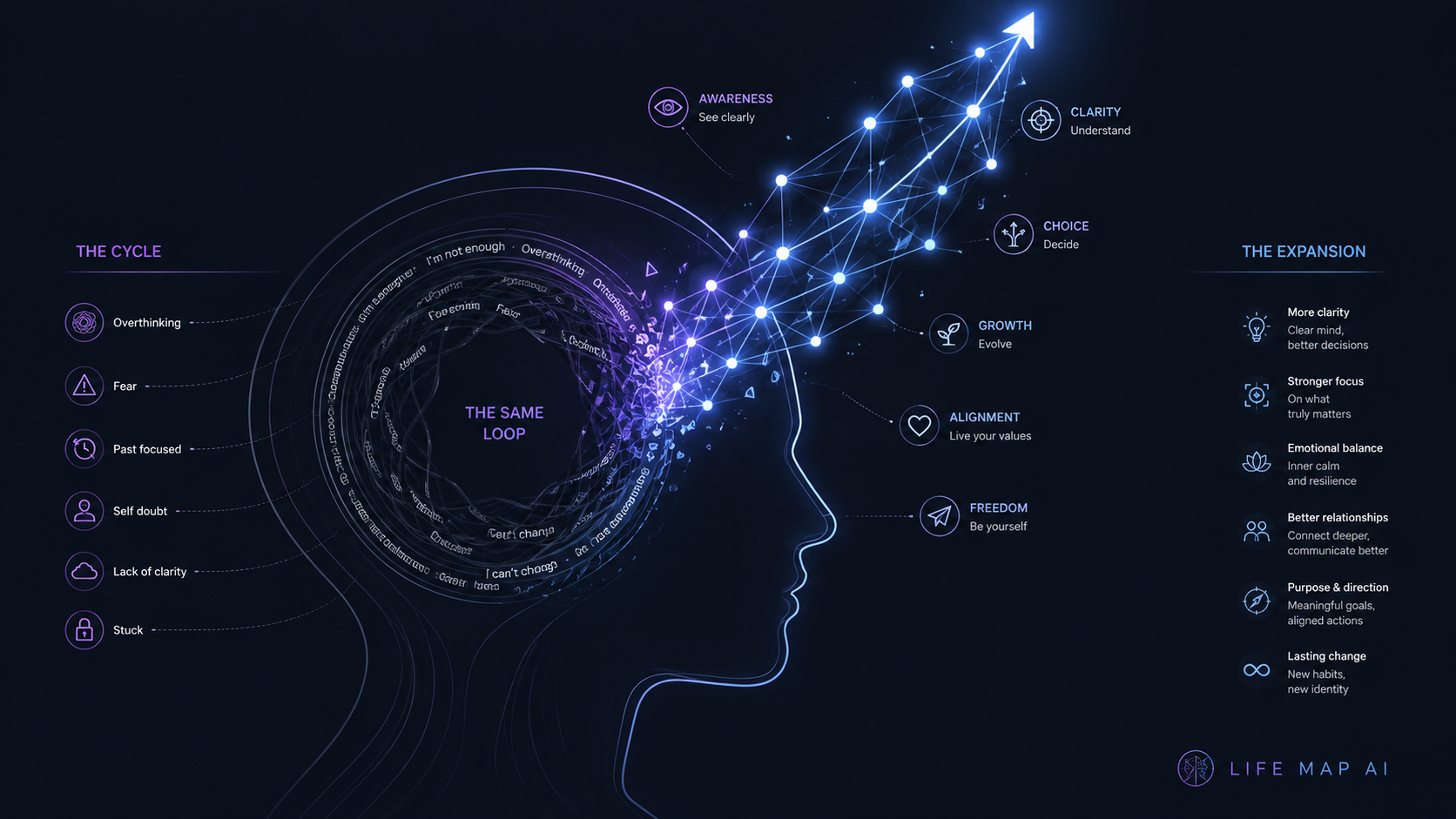
  • A glowing human profile showing a dark repetitive mental loop breaking into an expanding network of awareness, clarity, choice, growth, alignment, and freedom.
    ScholarlyArticle· 5 мин чтения

    Mapping Narrative Loops: How to Rewrite Your Inner Story

    Recurring thoughts often operate as hidden narrative loops. This article explains how spatial mapping can externalize these patterns, reveal their structure, and help create a deliberate alternative path.

  • Methodology Note· 12 мин чтения

    Что такое интерактивное картирование внутреннего мира?

    Методологическое введение в интерактивное картирование внутреннего мира — визуальный и динамический подход, лежащий в основе Life Map AI, для представления отношений, целей, страхов, надежд и ценностей в виде редактируемой карты для саморефлексии.

  • Featured Article· 6 мин чтения

    Memory Is Not a Recording. It’s a Reconstruction.

    Human memory does not preserve perfect recordings. It reconstructs experience through emotion, context, identity, and present understanding — and this matters for a Cognitive Operating System.