Anton Borts, BSW
Founder & Creator of Life Map AI
M.A. Psychology Candidate | Social Worker | Psychology Researcher
Introduction
Artificial intelligence is becoming an integral part of everyday life. It helps people search for information, write text, analyze data, generate images, and even support self-reflection. As AI systems become more capable, they also become more convincing. Their responses often appear logical, coherent, and confident.
However, convincing is not the same as correct.
AI does not perceive reality, experience emotions, or understand human life as people do. Instead, it identifies statistical patterns in vast amounts of data and predicts the most probable response within a given context. This approach enables remarkable capabilities while also creating important limitations.
Understanding where AI can be wrong is becoming just as important as understanding what it can do well.
1. AI Can Generate Incorrect Information
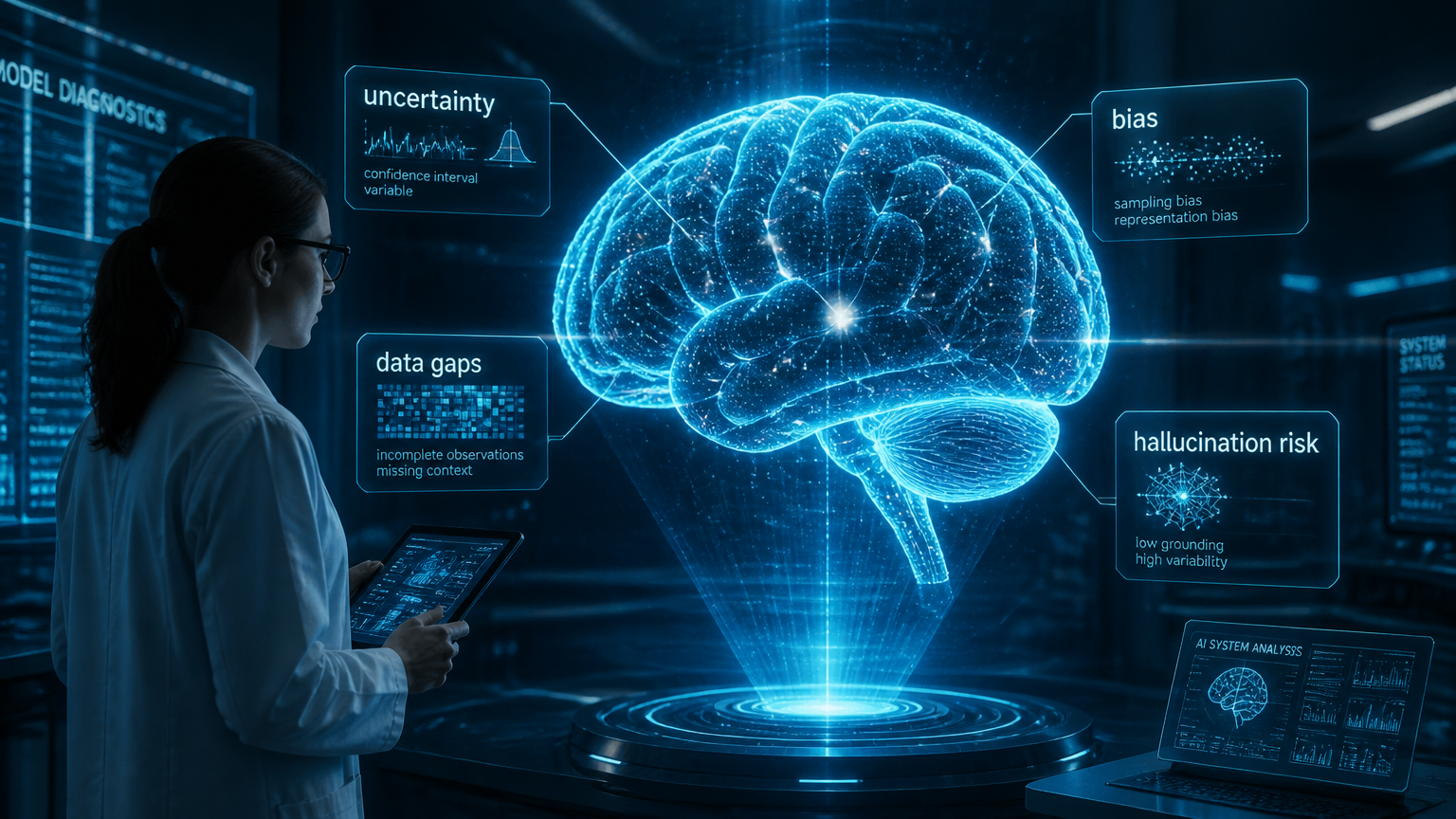
One of the best-known limitations of modern language models is hallucination—the generation of information that appears plausible but is factually incorrect. AI may invent references, misattribute quotations, describe events that never happened, or confidently present inaccurate explanations.
These errors are not necessarily software failures. They result from the probabilistic nature of generative AI, which predicts likely sequences of words rather than independently verifying facts.
For this reason, important information should always be checked against reliable sources.
2. AI Can Misunderstand Context
Human communication depends heavily on context. The same sentence or action can have different meanings depending on personal history, emotions, relationships, culture, or timing.
AI only has access to the information explicitly provided.
For example, if someone places "Career" at the center of a personal life map, AI may conclude that work is their highest priority. In reality, it could represent stress, uncertainty, obligation, or an area the person wants to change.
The same observation can support multiple valid interpretations.
3. AI Works With Incomplete Information
Every AI system is limited by the information it receives.
People rarely describe every relevant aspect of their lives. Important experiences, relationships, cultural influences, or recent events may be missing from the available data.
As a result, AI often builds conclusions from an incomplete picture rather than complete knowledge.
Absence of information should never be mistaken for absence of reality.
4. AI Learns From Imperfect Human Data
Modern AI systems are trained on enormous collections of human-generated content containing cultural biases, historical inaccuracies, conflicting opinions, outdated knowledge, and uneven representation of languages and communities.
Consequently, AI may reproduce patterns present in its training data rather than objectively describing reality.
Although researchers continuously work to reduce these biases, no current AI model is entirely free of them.
5. AI Cannot Experience Human Consciousness
Perhaps the most fundamental limitation is that AI has no subjective experience.
It does not experience fear, hope, grief, love, or uncertainty. It recognizes linguistic patterns associated with these concepts but does not understand them through lived experience.
This distinction becomes especially important when AI is used for self-reflection, mental health support, or complex personal decision-making.
6. Correlation Is Not Causation
AI excels at identifying patterns, but patterns do not automatically explain causes.
For example, anxiety and poor sleep frequently occur together. AI may recognize this relationship but cannot determine whether anxiety causes poor sleep, poor sleep causes anxiety, or both result from another underlying factor.
Moving from observation to explanation still requires human reasoning.
7. Confidence Does Not Equal Certainty
One characteristic of modern AI is its ability to express uncertain conclusions with fluent and confident language.
The quality of an answer reflects the model's ability to generate coherent text—not the certainty of its conclusions.
Responsible AI should encourage verification, transparency, and critical thinking rather than unquestioning acceptance.
Conclusion
Artificial intelligence is one of the most powerful cognitive tools humanity has ever created. Its greatest value lies not in replacing human judgment but in expanding it.
AI can organize information, identify hidden patterns, summarize complexity, and support reflection. Yet it cannot replace personal experience, human values, or individual responsibility.
The most responsible way to use artificial intelligence is not to let it think instead of us, but to let it help us think more clearly.
References
- Bender, E. M., Gebru, T., McMillan-Major, A., & Shmitchell, S. (2021). On the Dangers of Stochastic Parrots: Can Language Models Be Too Big? Proceedings of the 2021 ACM Conference on Fairness, Accountability, and Transparency.
- National Institute of Standards and Technology. (2023). Artificial Intelligence Risk Management Framework (AI RMF 1.0).
- UNESCO. (2021). Recommendation on the Ethics of Artificial Intelligence.
- Russell, S., & Norvig, P. (2021). Artificial Intelligence: A Modern Approach. Fourth Edition.
- OpenAI. Model system cards and safety documentation.
- Anthropic. Model system cards and responsible scaling documentation.