Anton Borts
Life Map AI Publications
Every day we make hundreds of decisions. Some are simple, while others shape our careers, relationships, health, identity, and future. Yet most of us attempt to solve complex problems in essentially the same way: we think in words. We replay conversations, make lists of pros and cons, write journal entries, and mentally rehearse the same arguments again and again.
This approach is often effective for straightforward problems. Human life, however, is rarely linear. The challenges that matter most usually involve multiple emotions, goals, responsibilities, fears, and relationships interacting simultaneously. As complexity grows, words alone can become insufficient. This is where visual thinking becomes especially valuable.
What Is Visual Thinking?
Visual thinking is the process of understanding complex information through spatial organization, visual relationships, symbols, diagrams, and external representations rather than relying exclusively on verbal reasoning.
Instead of keeping every thought inside working memory, visual thinking distributes information into an external visual space where relationships become visible and easier to explore. A goal may appear close or distant. A fear may seem larger than another concern. Two areas of life may reveal an unexpected connection, while an internal conflict can become visible as two competing directions rather than remaining an undifferentiated emotional experience.
Importantly, a visual representation is not an objective picture of the mind. It is an externalization of how a person currently experiences and organizes a particular situation. This distinction is essential. A visual map does not tell you who you are. Instead, it gives you something you can observe, question, reorganize, compare, and reinterpret. The map becomes a cognitive workspace rather than a psychological verdict. A closely related idea is described in Interactive Inner World Mapping.
Why Our Brains Benefit from External Representations
For decades, cognitive scientists have studied why diagrams, maps, sketches, and other visual representations can improve reasoning. The explanation is deeper than the simple claim that pictures are easier to understand. External visual representations can become part of the thinking process itself.
Instead of forcing the brain to maintain every relationship in working memory, the environment can carry part of the cognitive load. External representations can reduce memory demands, organize information spatially, create stable reference points, and support reasoning about relationships that would otherwise have to remain mentally active at the same time.
In other words, people are no longer thinking only inside their minds. They are thinking with the visual structure placed in front of them. The external representation becomes an active cognitive aid rather than a passive illustration.
From Linear Thinking to Spatial Thinking
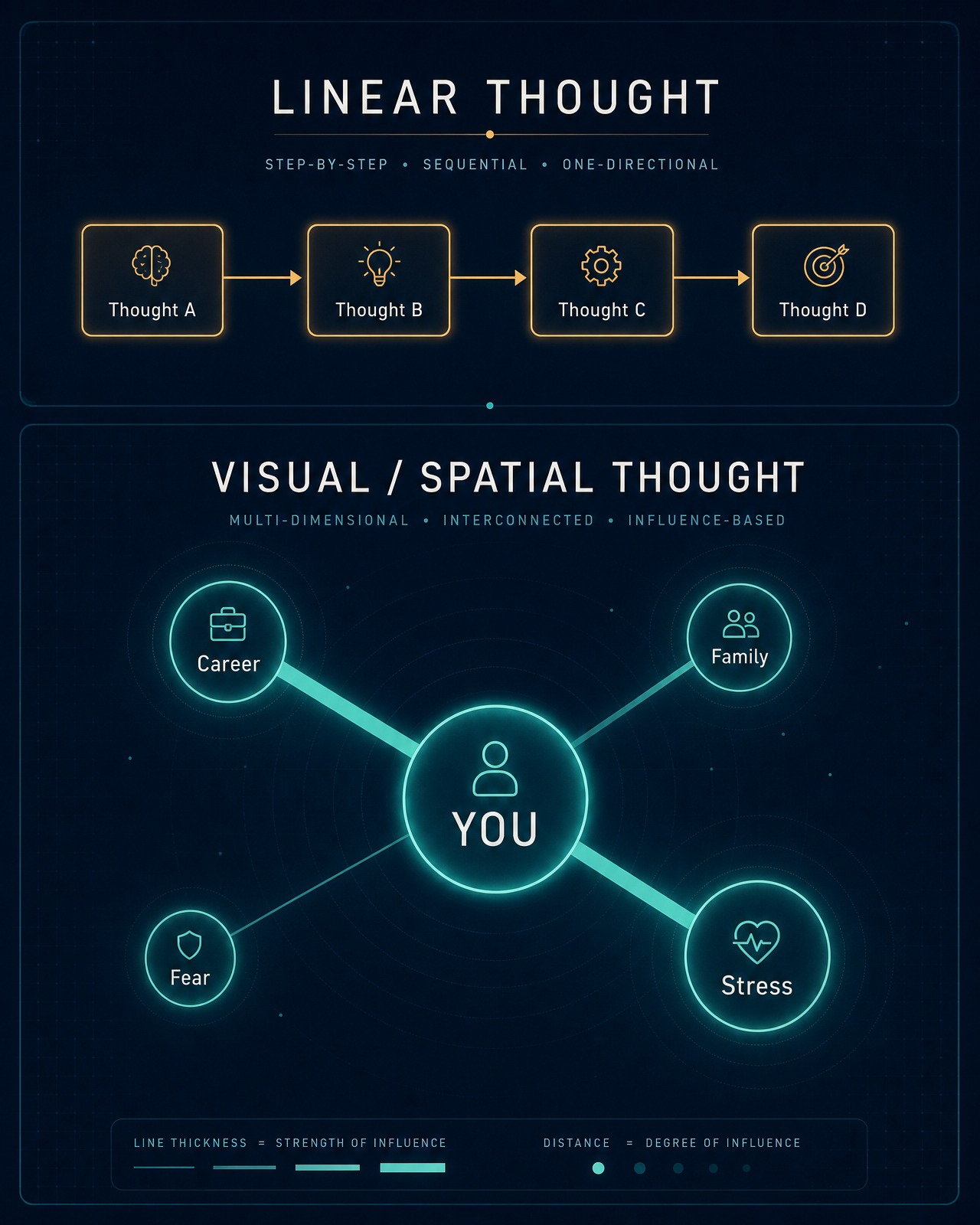
Traditional thinking often unfolds in sequence. One thought leads to another, creating a linear chain that works well for storytelling, explanation, and language. Complex life situations, however, rarely behave in this way.
A difficult career decision, for example, may simultaneously involve financial security, family expectations, personal values, fear of failure, health, identity, relationships, and future opportunities. None of these factors necessarily exists independently. They can interact with one another continuously.
Spatial thinking allows these factors to exist on the same visual canvas at the same time. Instead of forcing the mind to constantly switch between separate ideas, the larger system becomes easier to inspect.
Rather than asking only, “What am I thinking?”, a person can begin asking different kinds of questions: What is closest to me right now? Which element feels disproportionately large? Which parts of my life seem connected? What is competing for my attention? What has changed over time?
These questions emerge naturally when the structure itself becomes visible.
Visual Thinking Is Not Just for Designers
Visual thinking is sometimes associated primarily with artists, architects, or designers. Scientific research, however, shows that visual and spatial reasoning play important roles across many fields, including engineering, medicine, education, geography, mathematics, design, and scientific research.
Complex systems are often easier to reason about when relationships can be represented visually rather than held entirely in verbal form.
What is much less explored is how these same principles may support personal self-reflection.
Applying Visual Thinking to Your Inner World
Most visual thinking tools were originally designed for information.
Mind maps organize ideas. Whiteboards organize projects. Flowcharts organize processes. Knowledge graphs organize information.
Human experience, however, is also complex. Goals can influence motivation. Relationships can influence stress. Values can influence decisions. Fear can influence avoidance. Hope can influence action.
Instead of treating these experiences as isolated thoughts, they can be represented as parts of an interconnected personal landscape.
This is one of the ideas behind Life Map AI.
Life Map AI does not attempt to diagnose the person or claim to reveal hidden truths. Instead, it gives the user a spatial canvas on which personally meaningful elements can be placed, resized, connected, compared, and observed across time.
The individual remains the final interpreter of the map.
The system can support reflection, but meaning belongs to the person who created it.
How Visual Thinking Can Help Anyone
Visual thinking is not limited to specialists. Its principles can be useful whenever a situation becomes too complex to keep entirely in one's head.
A visual representation can help a person organize competing priorities, clarify difficult decisions, identify relationships between life domains, and reduce the amount of information that must remain active in working memory. It can also make recurring patterns easier to notice because several elements can be viewed simultaneously rather than reconstructed from memory one by one — an idea explored further in Narrative Loops and in the Decision Map.
Visual thinking may also support communication. A complicated situation that takes several paragraphs to describe can sometimes be represented as a small network of relationships, priorities, and tensions. The purpose is not to simplify human experience into a diagram, but to create another perspective from which the experience can be examined.
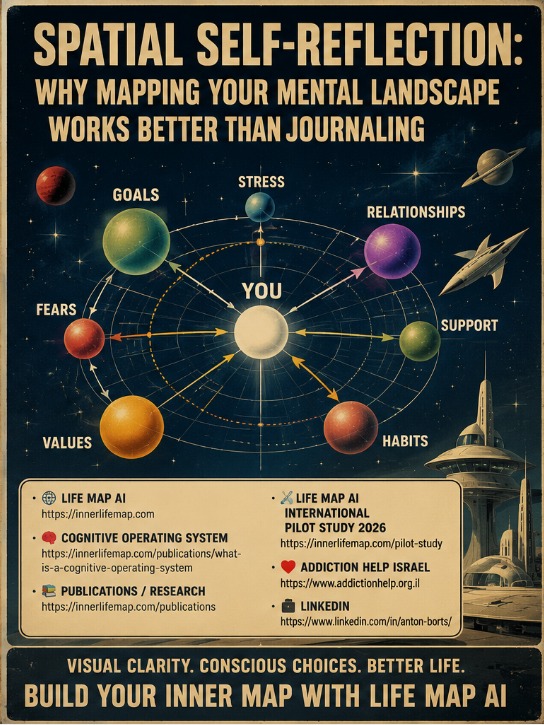
In self-reflection, this can mean moving from a vague statement such as “Everything feels overwhelming” toward a more differentiated picture: work is close to the center, financial uncertainty is strongly connected to it, family is both a responsibility and a source of support, while a long-term goal has gradually moved closer over time. This is the terrain of Spatial Self-Reflection.
The visual map does not decide what any of this means. It simply makes the structure easier to inspect.
Seeing Change
One of the most interesting possibilities of visual thinking is that change itself can become visible.
Thoughts change. Relationships change. Priorities change. Goals move closer or farther away. Sources of stress can become larger or smaller. New relationships between different parts of life can appear.
When those changes remain only in memory, they may be difficult to recognize accurately.
A visual history creates another kind of question.
Instead of asking only: “Am I making progress?”
a person can ask: “What changed?”
For Life Map AI, this idea is reflected in features such as Time Machine, where saved maps can be compared across time. The purpose is not to tell the user whether they improved, but to allow the user to observe their own changing representation of life.
Beyond Journaling
Journaling remains a valuable tool for self-reflection. Visual thinking does not need to replace it.
The two approaches work differently.
Writing is especially powerful for narrative, emotional expression, memory, and detailed explanation. Visual thinking is particularly useful for representing relationships, priorities, conflicts, distance, relative importance, and change.
Writing helps describe experience.
Visual thinking helps organize experience.
Used together, they can provide complementary perspectives on the same situation — something a short daily visual reflection can make concrete.
Visual Thinking, AI, and Life Map AI
Artificial intelligence introduces another layer to visual reflection, but it must be used carefully.
An AI system should not look at a personal map and declare what the person “really” thinks, wants, or feels. Spatial relationships chosen by the user are observations provided by the user, not psychological facts discovered by the machine.
Life Map AI is designed around this distinction, and the wider framing is described in What Is a Cognitive Operating System?
The system can ask reflective questions based on what the user has explicitly represented. It can notice that two elements were connected by the user, that an object moved between saved maps, or that one element was positioned closer to the center than another.
But interpretation should remain tentative, transparent, and user-controlled.
The goal is not automated psychological judgment.
The goal is better questions.
Looking Forward
The scientific study of visual thinking has largely focused on education, engineering, design, spatial cognition, and scientific reasoning. Applying these principles to personal reflection is a newer direction and should not be presented as a settled psychological intervention.
Yet the underlying idea is compelling.
As interactive technologies evolve, people may increasingly move from simply recording their thoughts toward interacting with representations of them.
Life Map AI was created around this possibility: not to tell people who they are, but to help them see what they already know from a different perspective.
Visual thinking does not replace reflection.
It changes the medium through which reflection happens.
Sometimes clarity does not come from thinking harder.
Sometimes it comes from seeing differently.
Ready to see your inner world from a different perspective?
Build Your Inner Map on Life Map AI →
References
- Hegarty, M. (2011). The Cognitive Science of Visual-Spatial Displays: Implications for Design. Topics in Cognitive Science, 3(3), 446–474. https://doi.org/10.1111/j.1756-8765.2011.01150.x
- Kirsh, D. (2010). Thinking with External Representations. AI & Society, 25, 441–454. https://doi.org/10.1007/s00146-010-0272-8
- Tommasi, L. (2012). Psychology of Spatial Cognition. WIREs Cognitive Science, 3(6), 565–580. https://doi.org/10.1002/wcs.1198
- Taylor, H. A., Burte, H., & Renshaw, K. T. (2023). Connecting spatial thinking to STEM learning through visualizations. Nature Reviews Psychology, 2, 637–653. https://doi.org/10.1038/s44159-023-00224-6